
Robohub.org
Indoor drone shows are here
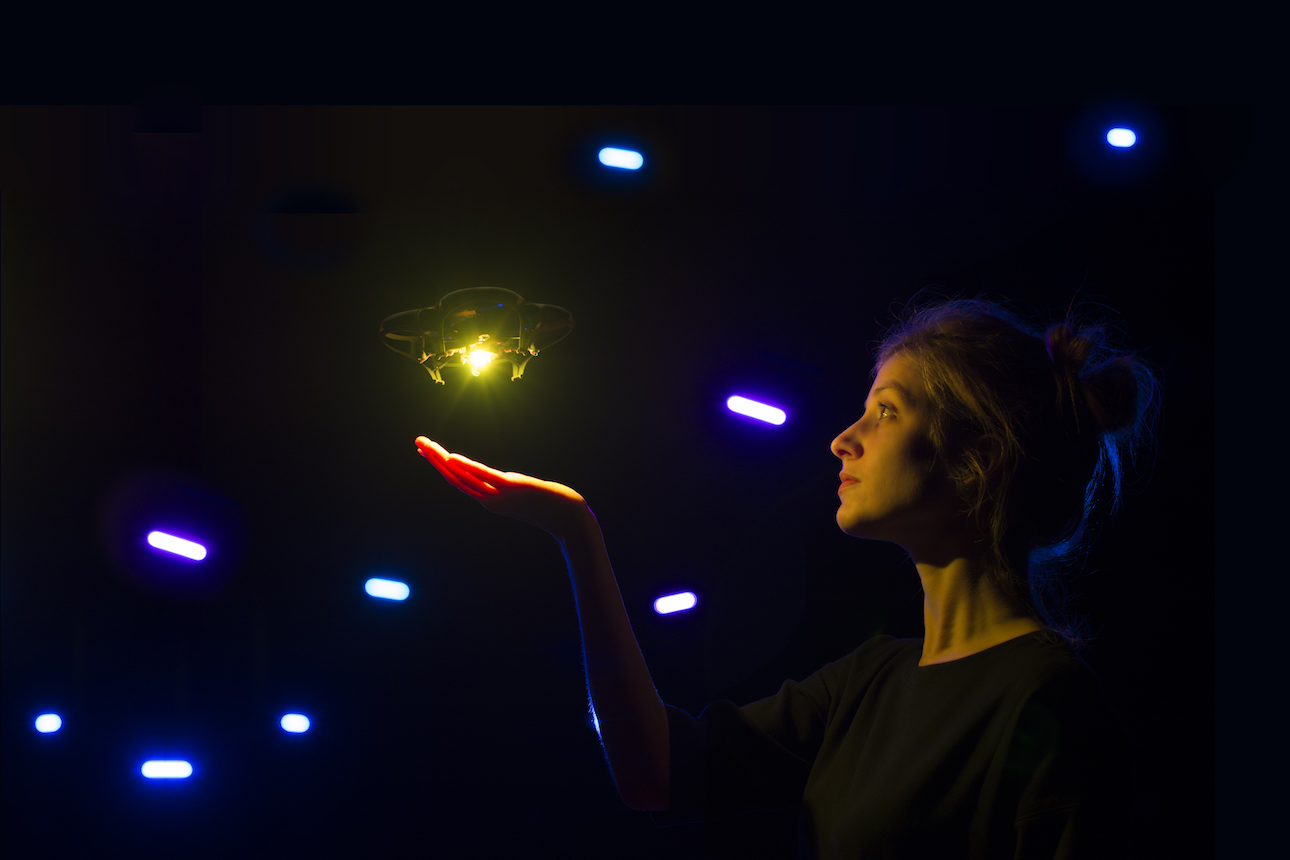
A Lucie micro drone takes off from a performer’s hand as part of a drone show. Photo: Verity Studios 2017
2017 was the year where indoor drone shows came into their own. Verity Studios’ Lucie drones alone completed more than 20,000 autonomous flights. A Synthetic Swarm of 99 Lucie micro drones started touring with Metallica (the tour is ongoing and was just announced the 5th highest grossing tour worldwide for 2017). Micro drones are now performing at Madison Square Garden as part of each New York Knicks home game — the first resident drone show in a full-scale arena setting. Since early 2017, a drone swarm has been performing weekly on a first cruise ship. And micro drones performed thousands of flights at Changi Airport Singapore as part of its 2017 Christmas show.
Technologically, indoor drone show systems are challenging. They are among the most sophisticated automation systems in existence, with dozens of autonomous robotic aircraft operating in a safety-critical environment. Indoor drone shows require sophisticated, distributed system control and communications architectures to split up and recombine sensing and computation between aircraft and their off-board infrastructure. Core challenges are not unlike those found in modern systems for manned aviation (e.g., combining auto-pilots, GPS, and air traffic control) and in creating tomorrow’s smart cities (e.g., combining semi-autonomous cars with intelligent traffic lights in a city).
These technological challenges are compounded by another: At least for permanent show installations, these systems need to be operated by non-experts. Two years ago, in one of the first major indoor drone shows, a swarm of micro drones flew over the audience at TED 2016. That system was operated by Verity Studios’ expert engineers. Creating a system that is easy enough to use, and reliable enough, to be operated by show staff is a huge technical challenge of its own. All of Verity’s 2017 shows mentioned above were fully client-operated, which speaks to the maturity that Verity’s drone show system has achieved.
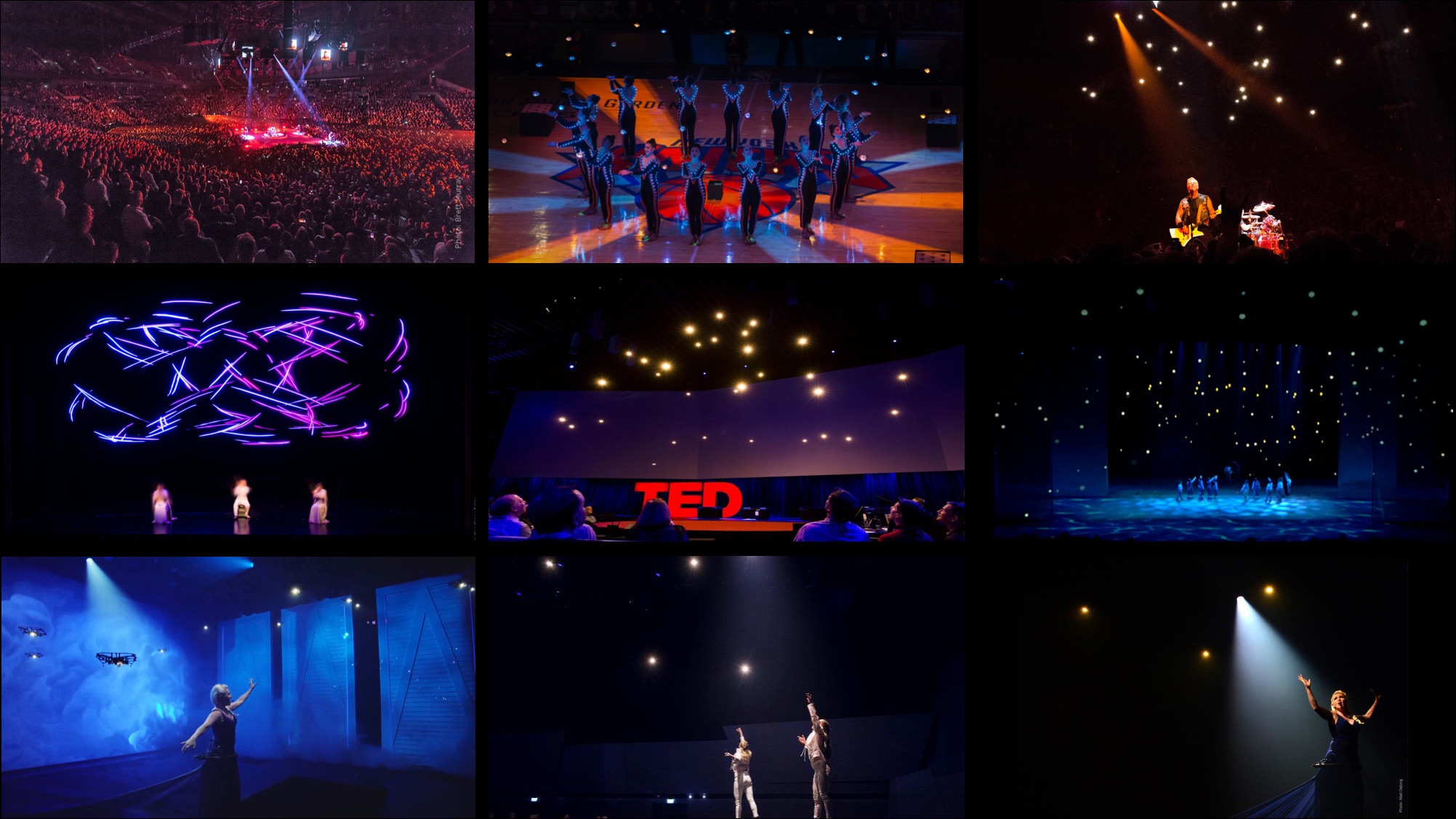
Selection of Verity Studios’ indoor drone shows, from the drone swarm at TED 2016 to 20,000 autonomous indoor drone show flights in 2017 alone.
For my colleagues and me, it is these technological challenges, together with the visual impact of indoor drone shows, that makes these systems so much fun and hugely rewarding to work with.
Creative potential
Creatively, the capabilities of today’s indoor drone show systems barely scratch the surface of the technology’s potential. For centuries, show designers were restricted to static scenes. Curtains were required to hide scene changes from the audience, lest stage hands rushing to move set pieces destroy the magic created by a live show. The introduction of automation to seamlessly move backdrops and other stage elements, followed by the debut of automated lighting to smoothly pan and tilt traditional, stationary illumination were revolutionary.
Drones hold the potential for pushing automation further. The Lucies shown in the images above give a first inkling of the creative potential of flying lights that can be freely positioned in 3D space, appearing at will. Larger drones allow to extend that concept to nearly any object, including the creation of flying characters.
Safety
The most critical challenge for indoor drone show systems is safety. Indoor drone shows feature dozens of drones flying simultaneously and in tight formations, close to crowds of people, in a repeated fashion, in the high-pressure environment of a live show. For example, as part of the currently running New York Knicks drone show, 32 drones perform above 16 dancers, live in front of up to 20,000 people in New York’s Madison Square Garden arena, 44 times per season.
There are really only three ways to safely fly drones at live events.
The first way to achieve safety is the same that keeps commercial aviation safe: System redundancy. Using this approach, Verity Studios’ larger, Stage Flyer drones performed safely on Broadway, completing 398 shows and more than 7,000 autonomous flights, flying 8 times a week, in front of up to 2,000 people for a year, without safety nets. The Stage Flyer drones are designed around redundancy. At least two of each components are used (e.g., two batteries, two flight computers, and a duplicate of each sensor) or existing redundancies are exploited. For example, the Stage Flyer drones have only four propellers and motors, like any quadcopter. However, advanced algorithms that exploit the physics of flight allow these multi-rotor vehicles to fly with less than 4 propellers. The overall design allows these drones to continue to fly in spite of any individual component failure. For example, in one of the last Broadway shows, a Stage Flyer experienced a battery failure. The drone switched into its safety flight mode and landed, and the show continued with 7 instead of 8 drones. This approach to drone safety remains highly unusual — all drones available for purchase today have single points of failure.
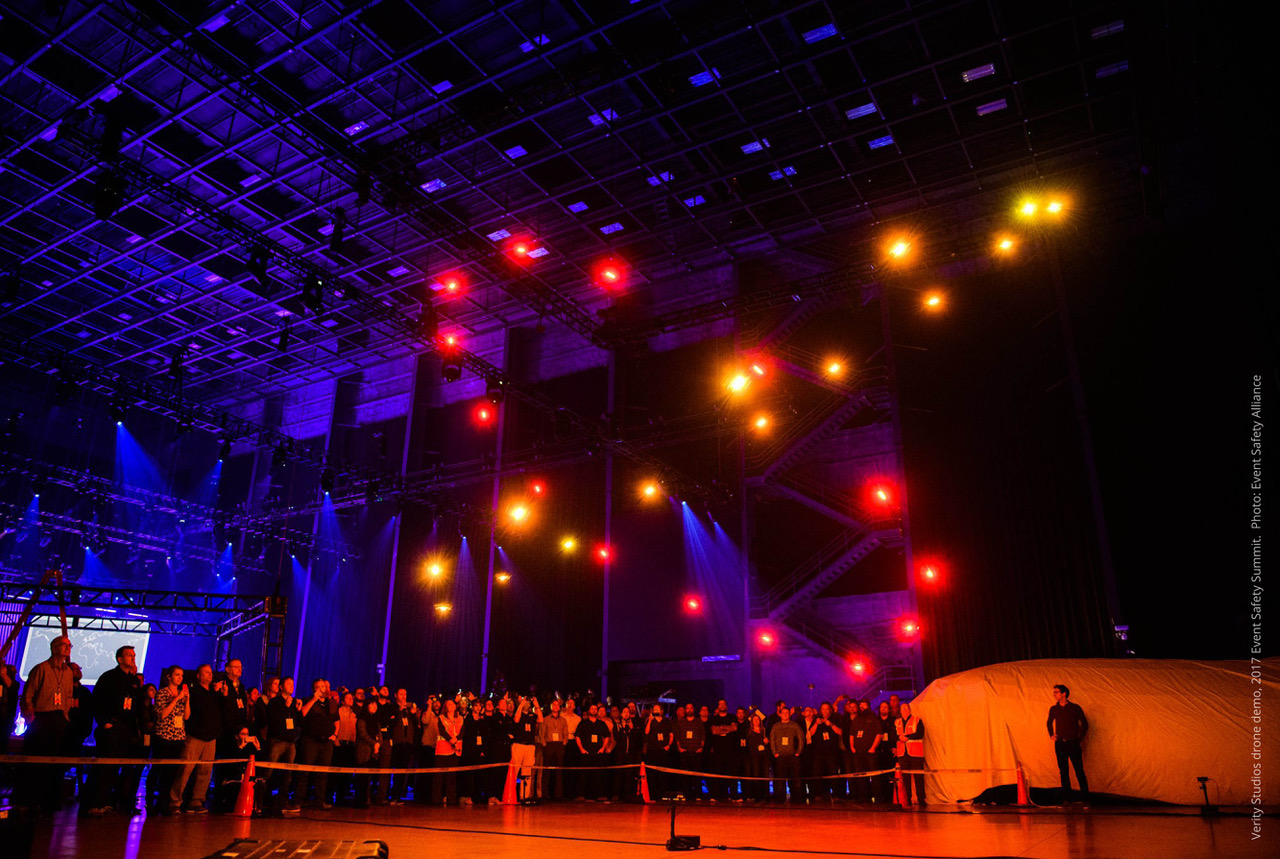
Verity Studios drone show, 2017 Event Safety Summit, Rock Lititz. Photo: Event Safety Alliance 2017
The second approach to safety is physical separation. This is how safety is usually achieved for outdoor drone shows: Drones perform over a body of water or some roads are temporarily closed to create a large-enough area without people. For example, the Intel drone show at the Super Bowl was recorded far away from the NRG stadium. In fact, for the Super Bowl, safety went even a step further, also adding “temporal separation” to the physical separation (the drone show was actually pre-recorded days ahead of time, and viewers in the stadium and on TV were only shown a video recording). For indoor drone lightshows, physical separation can be achieved using safety nets.
The third approach to safely flying drones at live events is to make the drones so small that they have high inherent safety. Verity Studios’ Lucie micro drones weigh less than 1.8 ounces or 50 grams (including their flexible hull).
As the continuing string of safety incidents involving drones at live events attests, not everyone takes drone safety seriously. This is why my colleagues and I have worked with aviation experts and leading creatives to summarize best practices in an overview paper: Drone shows – Creative potential and best practices.
So, what’s in store for 2018? The appetite for indoor drone shows is huge, which is why Verity Studios is growing its team. And given the 2017 track record, there is a lot to look forward to — your favorite venue’s ceiling is the limit!
tags: Algorithm Controls, Business, c-Arts-Entertainment, cx-Aerial, cx-Arts-Entertainment, entertainment, Flying, herotagrc, opinion, Robotics technology, Service Professional Other, Swarming

AUAI is supported by:









