
Robohub.org
Drone registration Task Force makes 11 key recommendations
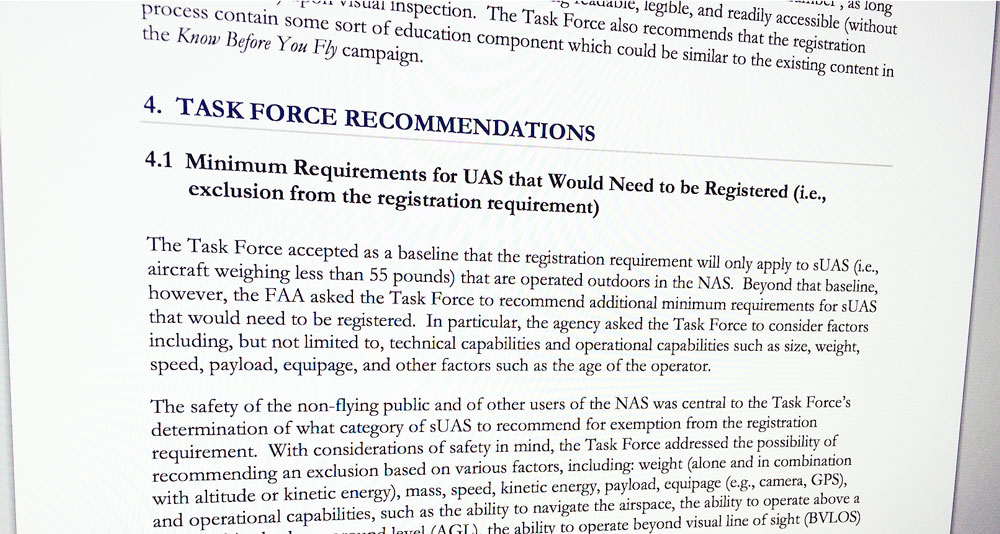
After the Task Force agreed that it was outside the scope of their objectives to debate or discuss the DOT Secretary’s decision to require registration, they undertook to develop and recommend a registration process that ensures accountability and encourages a maximum level of compliance. Here are their recommendations.
- Drones between 250 grams (.55 pounds) and 55 pounds that are operated outdoors need to be registered
- The registration is owner-based, so one number can apply to all the drones an owner has
- Registration will be mandatory at the time of operation and not the point of sale
- The owner’s name and street address will be mandatory (no P.O. Boxes). Other information, such as email address or cell phone number will be optional
- There is no citizenship requirement
- Minimum age to register is 13
- No fee for registration
- Registration will be web-based with the FAA to provide that site
- A registration certificate will be mailed to the owner
- The registration number (or the manufacturer’s serial number if permanently affixed to the drone) will need to be put on each drone
- Penalty for non-compliance are in excess of $25,000.00
The FAA and DOT will review and implement these recommendations into their already-late regulation(s).
You can read the Task Force’s full report here. More coverage coming soon. If you liked this post, you may also be interested in:
tags: drone regulations, FAA, politics, UAVs & drones

Frank Tobe
is the owner and publisher of The Robot Report, and is also a panel member for Robohub's Robotics by Invitation series.
Frank Tobe
is the owner and publisher of The Robot Report, and is also a panel member for Robohub's Robotics by Invitation series.
AUAI is supported by:









Related posts :
Robots in Society, Business and Culture: September 2026
IEEE Robotics and Automation Society (RAS)
26 Oct 2026
We showcase a selection of robotics stories from society, business, research and culture.
Robot Talk Episode 167 – Automating construction, with Jan Petrš
Robot Talk
23 Oct 2026
In the latest episode of the Robot Talk podcast, Claire chatted to Jan Petrš from École Polytechnique Fédérale de Lausanne about novel robot designs for construction and architecture.
ACM SIGAI Autonomous Agents Award 2027 open for nominations
ACM SIGAI
20 Oct 2026
Nominations are solicited for the 2027 ACM SIGAI Autonomous Agents Research Award.
Powered by muscle cells, a paper-thin robot swims through watery maze
MIT News
19 Oct 2026
MIT engineers’ new aquabot offers a way to design small, efficient “biohybrid” robots.
Robot Talk Episode 166 – Evolving robot bodies and brains, with Rika Antonova
Robot Talk
16 Oct 2026
In the latest episode of the Robot Talk podcast, Claire chatted to Rika Antonova from the University of Cambridge about using artificial intelligence to develop complimentary robot hardware and algorithms.
Neurosymbolic planning using natural language communication for cooperative autonomous vehicles
Read about work that was nominated for the AAMAS 2026 best paper award.
Humanoid robots can sprint and box – but the real test is doing the laundry
The Conversation
12 Oct 2026
No robot system can yet reliably handle the whole laundry process. Even folding remains a challenge.
Robot Talk Episode 165 – Robots behind the research, with Kushant Patel
Robot Talk
09 Oct 2026
In the latest episode of the Robot Talk podcast, Claire chatted to Kushant Patel from Brookhaven National Laboratory about robots that work in scientific facilities, such as particle accelerators.

