
Robohub.org
Robohub Digest 06/15: DRC wraps up, Philae wakes up, and Asian dragons invest
A quick, hassle-free way to stay on top of robotics news , our robotics digest is released on the first Monday of every month. Sign up to get it in your inbox.
DRC denouement
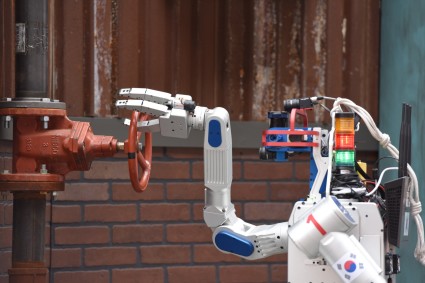
The robots may have been falling down, but DARPA left a brilliant PR legacy for robotics. Image source: DARPA.
Kicking off the month was the climax of the DARPA Robotics Challenge (DRC) – possibly the most anticipated robotic contest ever. The competition to develop a mobile robot capable of operating in hazardous environments saw 25 finalists compete for $3.5M in prize money, with KAIST (the Korea Advanced Institute of Science and Technology) crowned as ultimate victors. Although we did see a lot of robots falling down and staring at locked doors, the contest was deemed a success in community building and public relations. Rethink Robotics’ Rodney Brooks came up with what has to be the quote of the contest: “Anyone who is worried about the robot apocalypse just needs to keep their doors closed.”
That’s somewhat reassuring considering the Moscow Times reported that Russia is building a humanoid combat robot, which it says will be able to run and complete an obstacle course by the end of this year.
In the end, though, are humanoids are finally leaving the lab and doing useful things? SRI’s ultra-efficient DURUS robot (which was demoed at the DRC), and recent major funding announcements for Fetch and the developer of the Pepper robot Softbank (see below) suggest that may soon be the case.
Asian dragons
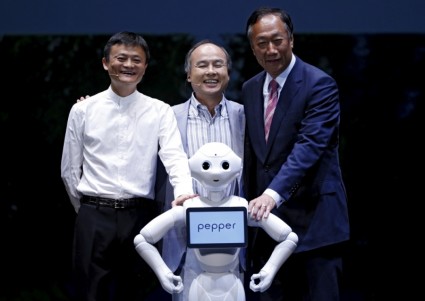
Chairmen from SoftBank, Foxconn and Alibaba pose with Pepper during the announcement of .
In June, Fetch announced new funding of $20M from Japanese multinational SoftBank, as well as O’Reilly AlphaTech and Shasta Ventures. Then Softbank itself received funding injections from Foxconn and Alibaba, who each invested $118m, providing further evidence that Asian forces are gearing up to dominate the robotics industry. This builds on news from April that Russia’s Skolkovo Foundation and the Chinese Cybernaut Investment Group signed an agreement to create a joint Russian-Chinese business incubator, a robotics accelerator program, and an investment fund worth $200m — essentially to import Russian tech and know-how into Chinese production facilities.
Currently, Japan leads in industrial robots, with the US second, according to figures from the Robotic Industries Association. But by 2017, China will have more factory robots than any other country. For more facts and figures on the rise of industrial automation, take a look at the Wall Street Journal, which devoted a whole section to the topic last month.
Funding and IPOs for medical robotics
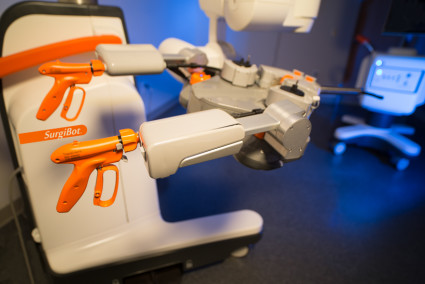
Transenterix’s SurgiBot system is presently awaiting FDA approval. They plan to use the $50M raised in their IPO to ramp up a sales force to market the new system.
Funding and IPOs for medical robotics this month: Corindus Vascular Robotics raised $42M, not to be outdone by surgical device maker Transenterix, which raised $50M from their IPO. The two join a growing list of publicly-traded robotic healthcare companies such as Accuray, Cyberdyne, Mazor Robotics, Hansen Medical, Stereotaxis, Intuitive Surgical, Titan Medical, Stryker and Johnson & Johnson.
Good news and bad for robots in space
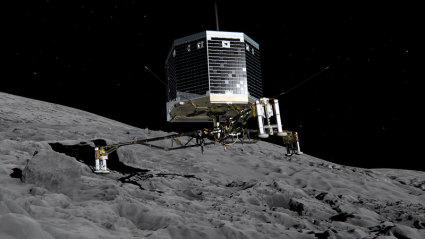 There was jubilation at the European Space Agency when unmanned comet lander Philae made contact after seven months of hibernation, having finally recharged its batteries after a bumpy landing left it on its side where sunlight had a hard time reaching its solar panels. The mission is now set to resume.
But the challenges of space flight were once again thrown into sharp relief when an unmanned SpaceX Falcon 9 rocket, bound for the International Space Station, exploded over the Atlantic, and a number of planned commercial operations were placed under threat.
European attitudes to robots
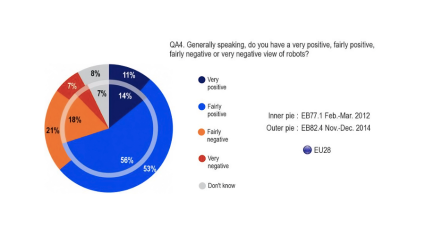
The Special Eurobarometer 427 on Autonomous Systems shows a slight decline in people’s attitudes towards robots since 2012, when the study was first conducted.
Back on the ground a major study reported that public perception of robots in the EU, while overall positive, is in decline. However, the study also showed that people’s exposure to robots is on the rise, and the more personal experience they have with robots, the more favourably they think of them.
Robocar news
This June the New York Times informed us that the future of transportation is already here and agricultural equipment manufacturer John Deere said nevermind Google’s small fleet of autonomous cars, it already has tens of thousands of self-driving tractors in service around the world.
Meanwhile Google appeared to be taking liability concerns head on by announcing it would release regular accident reports, while the head of its autonomous car programme, Chris Urmson, told the world in his TED talk that, statistically speaking, the least reliable part of the car is the driver. And keynoting at the Field and Service Robotics conference this month Urmson said his goal is to get the project on the road before his 12-year-old son needs to take a driving test.
Meanwhile, Chinese web services company, Baidu, announced a collaboration with BMW.
Research roundup
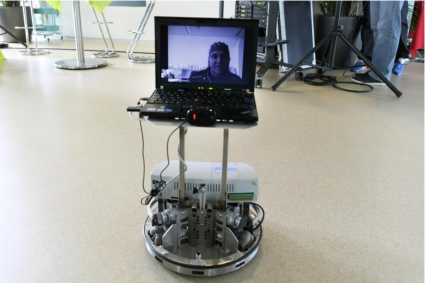
Controlling a mobile telepresence device through obstacles like doorways can be difficult when fine motor skills have been compromised, but this BCI device has shared control, making it far easier to navigate. (Photo: Alain Herzog, EPFL)
A shared-control BCI telepresence robot held out the promise of increased independence for those with mobility problems; robots learnt to push heavy objects with their bodies and a new algorithm helped a “Tailsitter” flying robot hover and recover easily.
Summer entertainment

Gemma Chan plays the synth Anita in Humans. Source: Channel 4
We were left unsettled but gripped by the new UK robot drama Humans, enlightened by 2015’s summer reading list, open-mouthed at the Yaskawa robot learning the art of the samurai, and fascinated by Andrew Whitehurst’s account of the visual effects in Ex Machina.
Robot Launch 2015
 Last but by no means least came the good news that the deadline for applications for Robohub’s and Silicon Valley Robotics’ very own startup competition – Robot Launch 2015 – has been extended to 12 July 2015. With a prize pool of more than $50K, what are you waiting for?! Get those entries in!
Events this July
- International Conference on Computer Vision Systems (ICVS) – July 6-9 -Copenhagen, Denmark
- CIROS 2015 – July 8-9 – Shanghai, China
- 2015 Robotics: Science and Systems Conference – July 13-17 – Rome, Italy
- IEEE CIS and RAM Conference – July 15-17 – Angkor Wat, Siem Reap, Cambodia
- International Conference on Advanced Robots (ICAR) – July 27-31 – İstanbul, Turkey
tags: Robohub Digest


AUAI is supported by:









