
Robohub.org
Robots begin to attack waste and dirt
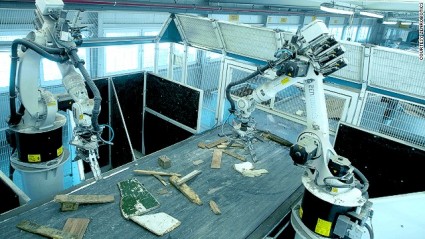
In Finland, there's an army of robots sorting, selecting and processing trash, while in Cincinnati bactobots are targeting and neutralizing bacteria in waste water. Here's a review of what is happening in the commercial world of cleaning and waste.
Waste recycling
Helsinki-based ZenRobotics has installed the first robotic waste sorting system in the world. Each robot system picks 12 million items a year from conveyors and sorts them into various bins. Currently picking and sorting construction and demolition waste, future versions will handle all sorts of waste material reclaiming that which can wbe reused and sorting out the rest for proper disposal treatment.
 ZenRobotics Recycler uses multiple sensors (visible spectrum cameras, NIR, 3D laser scanners, haptic sensors, etc) to create an accurate real-time analysis of the waste stream being processed. Based on the analysis, the system makes autonomous decisions on what objects to pick, how to grip the item and where to put it.
ZenRobotics uses KUKA robot arms connected to ZenRobotics custom-made grippers, vision and software systems. Waste sorting is rough and tumble and the gripper must manipulate objects without exact knowledge of their location, shape or composition but with knowledge of nearby robot picker activities.
ZenRobotics' clients include SITA, a waste management and trucking service, and Baetsen, a recycling and transport company.
Bacteria bots
Converting wastewater into something of value, eg, chemicals, water and gases, is a $10 billion industry and expected to grow to $27 billion in the next 7 years. Tauriga Sciences, a Canadian company in the nano-robotics space, has put together the intellectual property of Bacterial Robotics, an American firm engineering microscopic robots, and Pilus Energy, a Cinncinati-based company making the bactobots, and working with the City of Cinncinati wastewater treatment group to test their efficacy.
An army of bacterial robots started their first reconnaissance mission to purify Cincinnati, Ohio’s water supply and generate renewable energy in the process. These genetically enhanced microorganisms—dubbed bactobots—are part of a $1.7 million pilot project at Cincinnati’s Environmental Protection Agency. The project goal is to determine how the technology can be commercialized for use by a range of industry sectors, including municipal wastewater plants, food and beverage companies, and more.
Stella Sung, CEO of Tauriga Sciences, the company behind the bactobot technology, said, “There’s a huge need for better ways” to clean water for disposal or return to a city’s potable water system. “And there’s a lot of international need, so we’re working to get [bactobots] to China, Hong Kong, India, and the European Union.”
During the pilot program, the bactobots, so named because they labor like machines encoded to perform precise tasks, will be placed in an electrogenic bioreactor, or fuel cell. Wastewater is run through the fuel cell and treated inside it. Clean water emerges from one end of the reactor; energy emerges from the other in the form of hydrogen gas. At laboratory scale, when a mini-reactor held 10 gallons of water, the bactobots generated enough energy to charge a cell phone for five hours. An industrial-size reactor would hold millions of gallons of water, Sung said.
[Excerpted from Zumba for Bactobots on the Robot Rabbi blog.]
Although Pilus’ bactobots aren’t really robots, they are close. They sense, interpret and act in at least 2 dimensions. They aren’t reprogrammable because they’re disposable. So they don’t fit the formal definition of a service robot. They appear to be in the undefined transitory space between smart machines (in this case, biologically programmed machines) and thinking robots… a space housing a growing population of similar devices these days.
Industrial cleaners
Robotic consumer products for window, floor and carpet cleaning have made minimal inroads into the commercial/industrial marketplace. Demand for equipment is advancing at 1.7% CAGR. Big providers of washers, scrubbers, vacuums and steamers (such as Nilfisk, Electrolux, Katy and Tennant) don't offer any robotic products. Contract cleaners and house janitorial staffs still prefer walk-behind and ride-on devices. There are just a very few providers of robotic solutions thus far in this marketplace:
- Cyberdyne (Japanese) just launched a new $90,000 industrial office/factory/warehouse floor cleaner which can take an elevator by itself. Fuji Robotics and Sumitomo experimented for years with office cleaning robots for their high rise offices in Osaka but never brought the product(s) to market.
- Robosoft (French) has been providing robotic factory and garage floor cleaners for years and also provides glass cleaning for, amongst others, the glass Pyramide at the Louvre.
- Intellibot (American), a '90s buy-out from Nilfisk, has a full line of smart-looking robotic sweepers, vacuums and scrubbers.
- Cleanfix (Swiss), a conventional cleaning equipment provider, uses ultrasonic and infrared sensors as virtual bumper guards for their sole robotic floor cleaning (washing, scrubbing and drying) robots.
tags: business

AUAI is supported by:









