Robohub.org
 

The award-winning Smart Trash Can moves autonomously to catch your trash

by
15 February 2013


share this:
13-0013-r

This Smart Trash Can, developed by Minoru Kurata, an engineer at a Japanese auto maker, won an Excellence Award at the Japan Media Arts Festival.

“When you toss trash at it, a sensor detects the position of the trash, and sends the information to a PC. The PC calculates where the trash will fall, and communicates it to the can via wireless connection.”

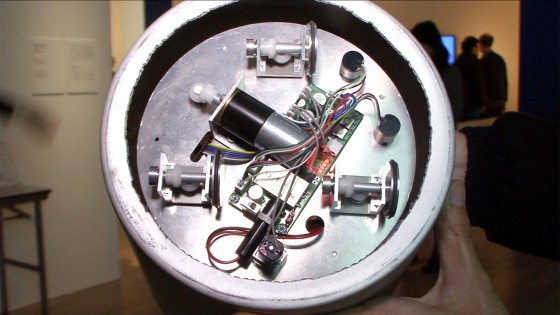
“The trash can has to move autonomously. To achieve that, I created a special mechanism, with a single axis for both the wheel rotation and the change in angle. So even if the wheels rotate, the position of the can itself doesn’t change. That mechanism, the circuitry, and the motor controller all fit within the diameter of the can. If the center of gravity is high, the can will fall over, so I made the can low, narrow, and compact, to keep the center of gravity as low as possible.”

“I’ve received inquiries about turning this into a commercial product. Right now, I’m working to patent the technology for the Smart Trash Can.”

“The probability that the trash will go in is not very high, only 10-20%. Even making full use of the current sensor, it still has errors. So I’d like to improve the success rate. I want to either improve the sensor, or upgrade the control by reducing the error through a program.”


tags: ,


DigInfo TV is a Tokyo-based online video news platform dedicated to producing original coverage of cutting edge technology, research and products from Japan.

            AUAI is supported by:


Subscribe to Robohub newsletter on substack


Related posts :

Developing active and flexible microrobots

  13 May 2026
This class of robots opens up possibilities for biomedical applications.

How to teach the same skill to different robots

  11 May 2026
A new framework to teach a skill to robots with different mechanical designs, allowing them to carry out the same task without rewriting code for each.

Robot Talk Episode 155 – Making aerial robots smarter, with Melissa Greeff

  08 May 2026
In the latest episode of the Robot Talk podcast, Claire chatted to Melissa Greeff from Queen's University about autonomous navigation and learning for drones.

New understanding of insect flight points way to stable flapping-wing robots

  07 May 2026
The way bugs and birds flap their wings may look effortless, but the dynamics that keep them aloft are dizzyingly complex and difficult to quantify.

Robotically assembled building blocks could make construction more efficient and sustainable

  05 May 2026
Research suggests constructing a simple building from interlocking subunits should be mechanically feasible and have a much smaller carbon footprint.

Robot Talk Episode 154 – Visual navigation in insects and robots, with Andrew Philippides

  01 May 2026
In the latest episode of the Robot Talk podcast, Claire chatted to Andrew Philippides from the University of Sussex about what we can learn from ants and bees to improve robot navigation.

Ultralightweight sonar plus AI lets tiny drones navigate like bats

  29 Apr 2026
Researchers develop ultrasound-based perception system inspired by bat echolocation.

Gradient-based planning for world models at longer horizons

  28 Apr 2026
What were the problems that motivated this project and what was the approach to address them?


AUAI is supported by:


Subscribe to Robohub newsletter on substack


©2026.02 - Association for the Understanding of Artificial Intelligence