Robohub.org
 

Liability concerns for drone co’s imposing technical measures to enforce no fly zones

by
03 February 2015


share this:
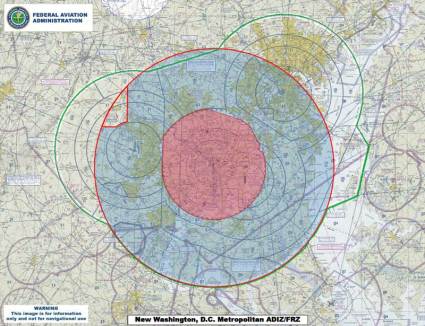
The Air Defense Identification Zone (ADIZ) surrounding Washington, D.C. Source: Wikipedia.

The Air Defense Identification Zone (ADIZ) surrounding Washington, D.C. Source: Wikipedia.

Shortly after a Phantom crash-landed on the grounds of the White House, its maker, DJI, announced that it would release a mandatory firmware update that would restrict flights within 15.5 miles of downtown Washington, D.C.

On Friday, Senator Schumer’s office released a statement urging the FAA to mandate that manufacturers impose technical controls to prevent drones from flying in high risk areas including near airports, other aircraft and the White House.

Whether drone manufacturers enforce “No Fly Zones” on their initiative as DJI has announced it will do, or whether they will be required to do so by the FAA at a later date, there are legal liability issues that should be considered.

If a manufacturer has not imposed technical measures to enforce No Fly Zones, and an operator enters a restricted area, liability is fairly straightforward. Assuming there is no design or manufacturing defect that causes the drone to fly into the restricted area, it is unlikely that the manufacturer would be held liable for any physical injury or property damage that may occur if the operator enters a No Fly Zone.

However, if a manufacturer implements technical measures to restrict drones from entering No Fly Zones, and such measures fail, they may be opening themselves up to legal liability if an operator flies into a restricted area and causes physical injury or property damage. Although it is unclear how liability may be allocated between an operator and a manufacturer in such a case, unless manufacturers are granted immunity from such lawsuits, they may be opening themselves up to liability by attempting to enforce No Fly Zones.


tags: , , , , ,


Diana Marina Cooper is Vice President of Legal and Policy Affairs at PrecisionHawk.

            AUAI is supported by:


Subscribe to Robohub newsletter on substack


Related posts :

How to teach the same skill to different robots

  11 May 2026
A new framework to teach a skill to robots with different mechanical designs, allowing them to carry out the same task without rewriting code for each.

Robot Talk Episode 155 – Making aerial robots smarter, with Melissa Greeff

  08 May 2026
In the latest episode of the Robot Talk podcast, Claire chatted to Melissa Greeff from Queen's University about autonomous navigation and learning for drones.

New understanding of insect flight points way to stable flapping-wing robots

  07 May 2026
The way bugs and birds flap their wings may look effortless, but the dynamics that keep them aloft are dizzyingly complex and difficult to quantify.

Robotically assembled building blocks could make construction more efficient and sustainable

  05 May 2026
Research suggests constructing a simple building from interlocking subunits should be mechanically feasible and have a much smaller carbon footprint.

Robot Talk Episode 154 – Visual navigation in insects and robots, with Andrew Philippides

  01 May 2026
In the latest episode of the Robot Talk podcast, Claire chatted to Andrew Philippides from the University of Sussex about what we can learn from ants and bees to improve robot navigation.

Ultralightweight sonar plus AI lets tiny drones navigate like bats

  29 Apr 2026
Researchers develop ultrasound-based perception system inspired by bat echolocation.

Gradient-based planning for world models at longer horizons

  28 Apr 2026
What were the problems that motivated this project and what was the approach to address them?

Robot Talk Episode 153 – Origami-inspired robots, with Chenying Liu

  24 Apr 2026
In the latest episode of the Robot Talk podcast, Claire chatted to Chenying Liu from University of Oxford about how a robot's physical form can actively contribute to sensing, processing, decision-making, and movement.


AUAI is supported by:


Subscribe to Robohub newsletter on substack


©2026.02 - Association for the Understanding of Artificial Intelligence