
Robohub.org
Residential robotic vacuum cleaner market poised for stellar growth
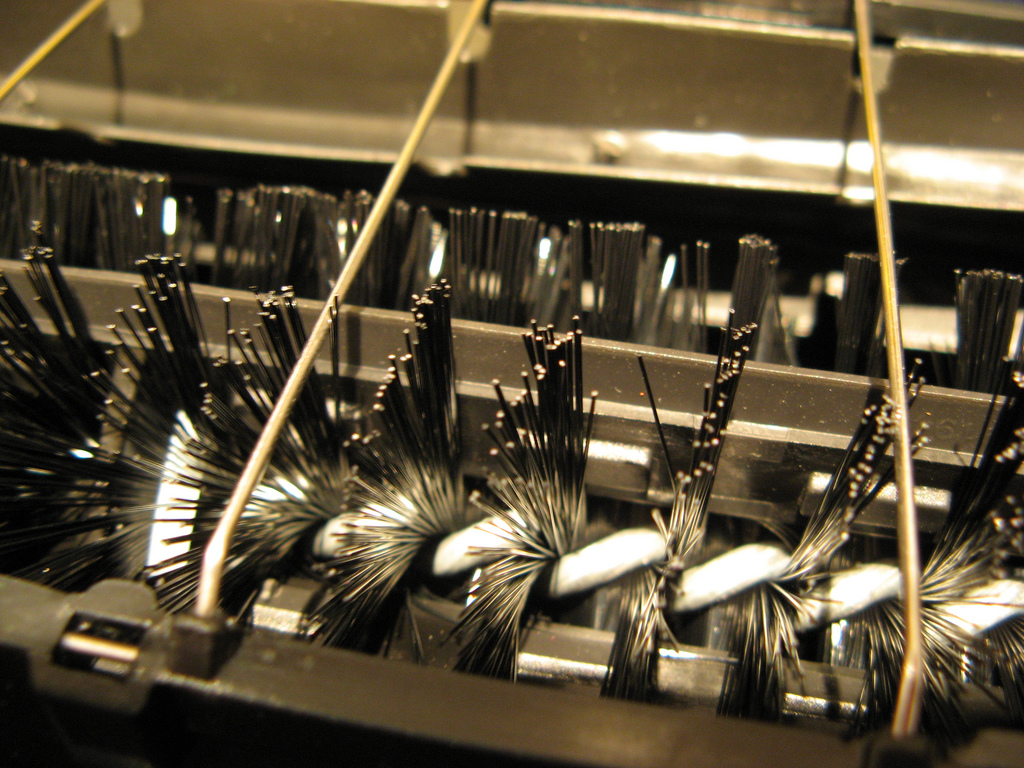
Image: Tnarik Innael/flickr
Although robotic vacuum cleaners have been on the market for over a decade now, it is only recently that they have started to become pervasive. Innovations in technology have allowed manufacturers to add more cleaning power and convenience features, and this has been a key factor in developing highly efficient and fully automated robotic vacuum cleaners.
Robotic vacuum cleaners, colloquially known as robovacs, are primarily used in residential spaces to clean pools, gutters and floors. Robovacs usually consist of a mobile base, programming software, cleaning system, batteries, and other accessories. Robovacs are autonomous and use intelligent sensors to clean even hard-to-reach surfaces. Robotic vacuum cleaners are also equipped with laser vision, room mapping, and self-empty — features designed to offer convenience and ease of use to the users.
Robovacs still form a miniscule percentage of the global vacuum cleaner market, but their acceptance is growing at a steady pace. Today’s busy lifestyles leave little or no time for home cleaning and other chores. This, coupled with the fact that most modern robotic vacuum cleaners offer fully automatic functionalities, are the prime reasons that have led to the demand for robovacs around the world, especially in developed countries.
Most advanced robovacs are priced around US$500 and above, and the high price has been a challenge for their adoption on a massive scale. However, manufacturers are optimistic that the advanced features of robovacs will compensate for the high price and consumers will eventually see the benefits of robotic vacuum cleaners.
Global Residential Robotic Vacuum Cleaner Market: Analysis & Region-wise Outlook
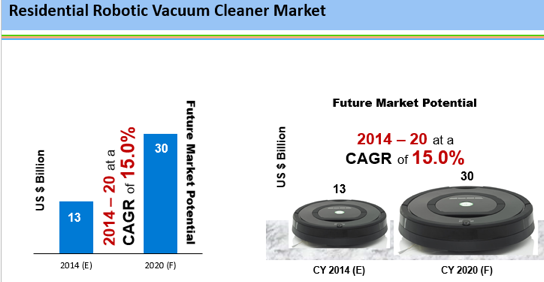
The global residential robotic vacuum cleaner market is anticipated to witness a compound annual growth rate (CAGR) of over 15%. The growth will be supported by the factors that we discussed above — time constraints for doing household chores, ease of using the robovacs, and the advent of advanced robovacs. The market value of the residential robotic vacuum cleaner market is anticipated to be worth US$ 3 billion by 2020.
The key markets are the US, Western Europe, and Asia Pacific (APAC). The residential robotic vacuum cleaner market in the US is anticipated to expand at a steady single-digit CAGR through 2020. Consumer awareness about robovacs and coverage of robotic products, in both print and digital media, has helped raise awareness amongst consumers, providing an impetus to the prospects of the residential robotic vacuum cleaner market in the US.
Western Europe is another lucrative region for the residential robotic vacuum cleaner market, and it is anticipated that in France, Germany, and UK the demand for robotic vacuum cleaners will be robust in the next five years.
APAC is another lucrative region for robotic vacuum cleaners. Japan, South Korea, Singapore, and Hong Kong are the regions where consumer awareness about robotic vacuum cleaners is relatively high compared to other APAC countries. Among these key regions, the Japanese residential robotic vacuum cleaner market is notable, due to the launch of innovative products in the country. Most talked-about has been the launch of the Dyson 360 Eye by Dyson Ltd., a UK. based technology firm. The Dyson 360 Eye was launched in September 2014 and is reported to have cost Dyson Ltd. a whopping US$47m in development and R&D. Although the device was launched amidst much fanfare and received positive reviews from analysts, it has its task cut out against iRobot Corp., which has around 80% share of the Japanese robotic vacuum cleaner market.
iRobot Corp., a US based advanced technology company, has maintained its dominance in the global residential robotic vacuum cleaner market. The company has been at the forefront of offering robotic vacuum cleaners with advanced features. Its range of Roomba® and Braava® vacuum cleaners have been well received in the market. Other key players in the residential robotic vacuum cleaners market include Electrolux, Hanool Robotics, Samsung Electronics Co. Ltd., Metapo, Inc., and LG Electronics, Inc.
Although still at a nascent stage, the market for residential robotic vacuum cleaners will witness steady growth in the future on account of technological advancement in the field of robotics, growing demand from tech-savvy consumers, and greater awareness.
The information presented in this article is sourced from Future Market Insights’ upcoming research report, Residential Robotic Vacuum Cleaner Market: Global Industry Analysis and Opportunity Assessment 2014 – 2020
tags: Dyson, household, iRobot, roomba

AUAI is supported by:









