
Robohub.org
The Robot Academy: Lessons in inverse kinematics and robot motion
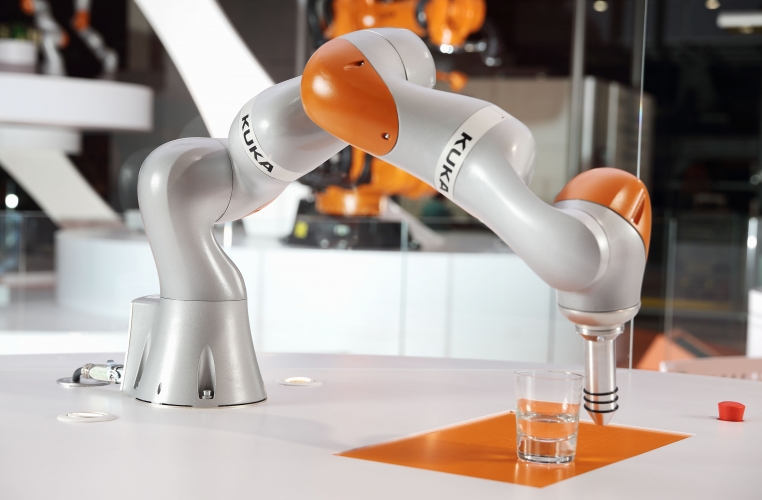
The Robot Academy is a new learning resource from Professor Peter Corke and the Queensland University of Technology (QUT), the team behind the award-winning Introduction to Robotics and Robotic Vision courses. There are over 200 lessons available, all for free.
The lessons were created in 2015 for the Introduction to Robotics and Robotic Vision courses. We describe our approach to creating the original courses in the article, An Innovative Educational Change: Massive Open Online Courses in Robotics and Robotic Vision. The courses were designed for university undergraduate students but many lessons are suitable for anybody, as you can easily see the difficulty rating for each lesson. Below are lessons from inverse kinematics and robot motion.
You can watch the entire masterclass on the Robot Academy website.
Introduction
In this video lecture, we will learn about inverse kinematics, that is, how to compute the robot’s joint angles given the desired pose of their end-effector and knowledge about the dimensions of its links. We will also learn about how to generate paths that lead to a smooth coordinated motion of the end-effector.
Inverse kinematics for a 2-joint robot arm using geometry
In this lesson, we revisit the simple 2-link planar robot and determine the inverse kinematic function using simple geometry and trigonometry.
Inverse kinematics for a 2-joint robot arm using algebra
You can watch the entire masterclass on the Robot Academy website.
If you liked this article, you may also enjoy:
- Smart Grasping System available on ROS Development Studio
- The Robot Academy: Lessons in image formation and 3D vision
- The Robot Academy: The open online robotics education resource
- Machine Learning with OpenAI Gym on ROS Development Studio
- SICK LMS full LIDAR teardown
- Envisioning the future of robotics
- How to mount an external removable hard drive on a robot
See all the latest robotics news on Robohub, or sign up for our weekly newsletter.
tags: actuation, control, video

AUAI is supported by:









