
Robohub.org
Bioinspired robotics #2: Materials, manufacturing & design, with Robert Wood
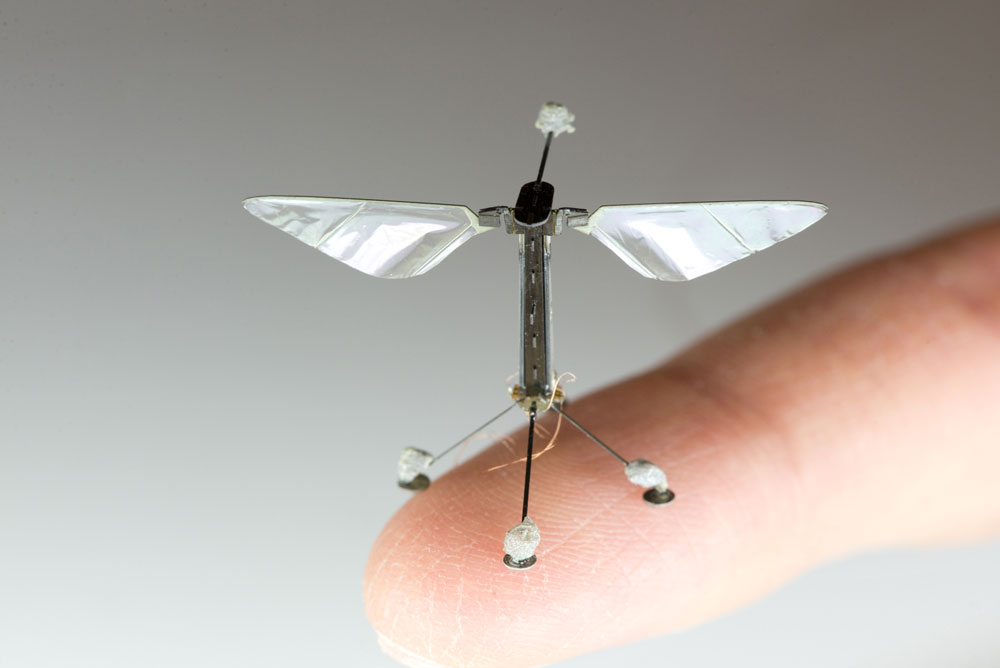
Source: Wyss Institute at Harvard University
In the Disruptive Podcast series, Terrence McNally speaks directly with Wyss Institute researchers, exploring what motivates them and how they envision our future as might be impacted by their disruptive technologies. In part 2 of the Disruptive: Bioinspired Robotics episode, Wyss Founding Core Faculty Member Robert Wood discusses new manufacturing techniques that are enabling popup and soft robots.
Wood is developing biologically inspired aerial and terrestrial microrobots, soft-bodied robots, and “printable” robots. His current research interests include new micro- and meso-scale manufacturing techniques, fluid mechanics of low Reynolds number flapping wings, control of sensor-limited and computation-limited systems, active soft materials, and morphable soft-bodied robots. He leads a team of over 40 researchers on the National Science Foundation (NSF) “RoboBees” project to develop coordinated colonies of autonomous robotic bees.
His group is also building agile ambulatory robots that are inspired by insects and centipedes. The long-term goal is to create a swarm of robotic insects capable of performing important tasks, such as search and rescue, hazardous environmental explorations, and pollination. Wood is collaborating with a diverse set of researchers at the Wyss who are exploring soft-bodied autonomous robots and soft devices for human-robot interaction and rehabilitation. One of these projects, called “Second Skin,” is a system in which sensing, actuation, and control mechanisms are embedded in soft devices that can be worn by patients with neuromuscular disorders to help them regain function. Wood is also working on novel manufacturing processes for “printable robots” with the goal of automating robot development and creating new methods for rapid prototyping complex electromechanical devices.
tags: bioinspired, Disruptive Podcast, podcast, research, Robobee, soft robotics, Wyss Institute

AUAI is supported by:









