Robohub.org
ep.

258

podcast
 

DART: Noise injection for robust imitation learning with Michael Laskey

by
14 April 2018


share this:


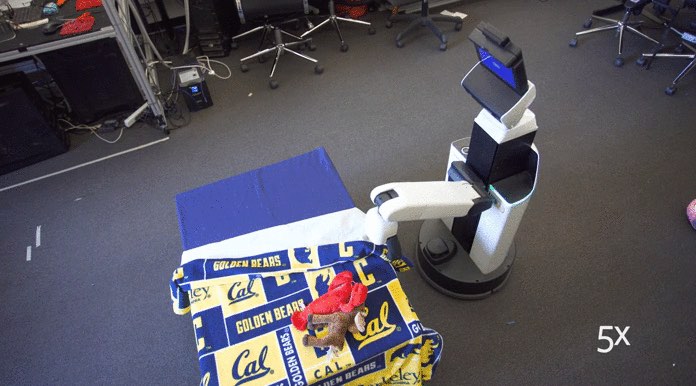
Toyota HSR Trained with DART to Make a Bed.

In this episode, Audrow Nash speaks with Michael Laskey, PhD student at UC Berkeley, about a method for robust imitation learning, called DART. Laskey discusses how DART relates to previous imitation learning methods, how this approach has been used for folding bed sheets, and on the importance of robotics leveraging theory in other disciplines.

To learn more, see this post on Robohub from the Berkeley Artificial Intelligence Research (BAIR) Lab.

Michael Laskey

Michael Laskey is a Ph.D. Candidate in EECS at UC Berkeley, advised by Prof. Ken Goldberg in the AUTOLAB (Automation Sciences). Michael’s Ph.D. develops new algorithms for Deep Learning of robust robot control policies and examines how to reliably apply recent deep learning advances for scalable robotics learning in challenging unstructured environments. Michael received a B.S. in Electrical Engineering from the University of Michigan, Ann Arbor. His work has been nominated for multiple best paper awards at IEEE, ICRA, and CASE and has been featured in news outlets such as MIT Tech Review and Fast Company.

Links


tags: , , ,


Audrow Nash is a Software Engineer at Open Robotics and the host of the Sense Think Act Podcast

            AUAI is supported by:


Subscribe to Robohub newsletter on substack


Related posts :

Robotics Café brings together autonomous robot practitioners

  20 May 2026
Recently launched series for researchers, students and industry practitioners aims to provide a platform for students to present their work.

Table tennis robot defeats some of world’s best players – why this has major implications for robotics

  18 May 2026
Ace, from Sony AI, is the first robot to beat elite human players in competitive physical sport.

Robot Talk Episode 156 – Rugged robots for dangerous missions, with Gavin Kenneally

  15 May 2026
In the latest episode of the Robot Talk podcast, Claire chatted to Gavin Kenneally from Ghost Robotics about robot dogs for defence, security, and public safety.

Developing active and flexible microrobots

  13 May 2026
This class of robots opens up possibilities for biomedical applications.

How to teach the same skill to different robots

  11 May 2026
A new framework to teach a skill to robots with different mechanical designs, allowing them to carry out the same task without rewriting code for each.

Robot Talk Episode 155 – Making aerial robots smarter, with Melissa Greeff

  08 May 2026
In the latest episode of the Robot Talk podcast, Claire chatted to Melissa Greeff from Queen's University about autonomous navigation and learning for drones.

New understanding of insect flight points way to stable flapping-wing robots

  07 May 2026
The way bugs and birds flap their wings may look effortless, but the dynamics that keep them aloft are dizzyingly complex and difficult to quantify.

Robotically assembled building blocks could make construction more efficient and sustainable

  05 May 2026
Research suggests constructing a simple building from interlocking subunits should be mechanically feasible and have a much smaller carbon footprint.


AUAI is supported by:


Subscribe to Robohub newsletter on substack


©2026.02 - Association for the Understanding of Artificial Intelligence