
Robohub.org
 

Industrial robot sales for 2015 set new record, despite troubles in China

by
22 June 2016


share this:
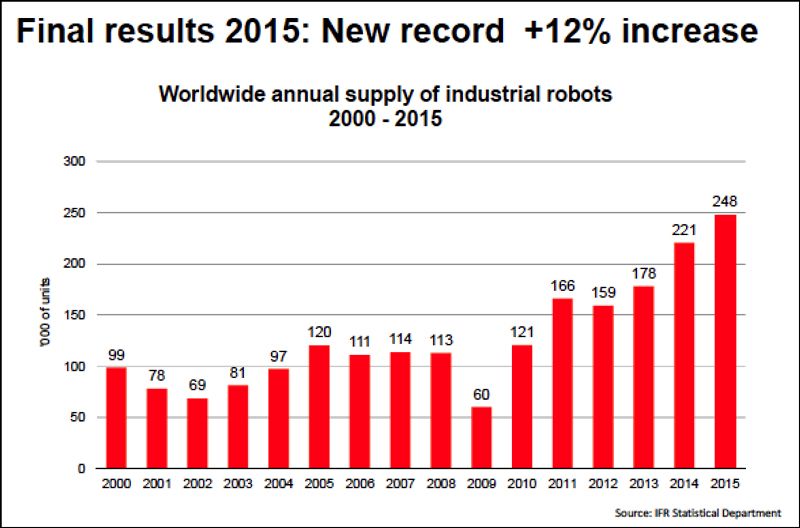
Source: IFR Statistical Department

Source: IFR Statistical Department

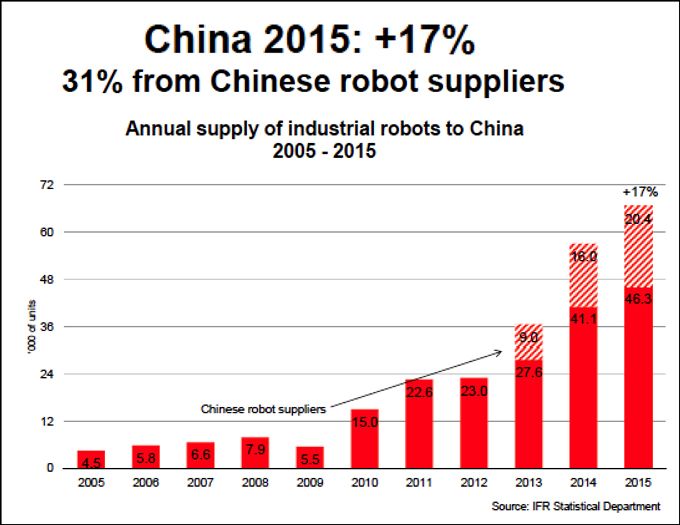
Worldwide sales of industrial robots set a new record: 248,000 units sold in 2015, 12% more than 2014. 66,700 units sold in China of which 20,400 were made in China.

Asia is still the strongest growth market with 156,000 units for the region, a 16% increase over 2014, but that figure is much lower than the 27% projected. The rate of growth of China-made robots penetrating the market also didn’t grow at the projected rate but it did grow at a healthy 31% rate.
Source: IRF Statistical Department

Source: IRF Statistical Department

At a press conference and CEO Roundtable held today at AUTOMATICA in Munich by the International Federation of Robotics (IFR), where these figures were presented, the consensus rationale for not meeting the overall and China projections was:

  1. that the robot-assisted electronics assembly market was nowhere near as strong as projected;
  2. that key components still had to be imported at high cost thereby making China’s robot makers have higher costs and higher selling prices than planned;
  3. and because China’s  auto industry was over-saturated with robots and needed time to integrate them into their systems before additional orders could be placed.

The IFR, in the remarks of their President, Joe Gemma, strongly believe that manufacturing jobs will change in the new era of digitalization and Industry 4.0. Workers will focus on jobs that require judgement, common sense, creativity, problem-solving and dexterity, and be freed from repetitive tasks. Further, mobile robots will optimize materials handling; collaborative robots will assist workers in a variety of tasks; and simplification of the use of robots will enable more companies to use robots.

For 2016, 2017 and 2018, the IFR is projecting an 18% CAGR (compounded annual growth rate).

At the IERA Awards ceremony held last night in Munich, the IFR/IEEE Invention and Entrepreneurship in Robotics and Automation (IERA) award was given to ABB Robotics for their two-armed YuMi collaborative robot.


tags: , , ,


Frank Tobe is the owner and publisher of The Robot Report, and is also a panel member for Robohub's Robotics by Invitation series.

            AUAI is supported by:


Subscribe to Robohub newsletter on substack


Related posts :

Robotics roadmaps from around the world spotlight of the month: United States of America

US robotics researchers and industry are looking for a cohesive national robotics strategy.

Could robots help tackle loneliness? BBC’s Ann Droid raises questions about the future of care

  07 Sep 2026
While the series exaggerates what robots can currently do, some of the technology it depicts is already being tested.

Exploring the Moon will require rovers that can think for themselves – an upcoming NASA mission will test whether they can

  04 Sep 2026
NASA is planning to send three small rovers to the Moon to autonomously compute how to best explore a patch of ground.

Surviving the paper deluge: Notes from an ICRA panel on publishing, LLMs, and the future of peer review

Experts discuss peer-review challenges and possibilities for reshaping the process.

When expressive humanoid robots are awkward, people become wary – new brain study

  31 Aug 2026
People become more suspicious of a humanoid robot that makes errors, especially when the robot is an expressive conversation partner.

First 11 vs 11 humanoid soccer game played at RoboCup 2026

  28 Aug 2026
Watch highlights from this historic match.

How green is your robot? And other awkward questions

Robots clean rivers and sort waste, monitor ecosystems, and inspect renewable-energy infrastructure. But even the greenest robot has an environmental footprint.

These tiny drones are powered by sound

  24 Aug 2026
EPFL engineers have designed acoustic cavities that convert sound waves into thrust, propelling small robots and ultralight aerial vehicles without on-board actuators or electronics.


AUAI is supported by:


Subscribe to Robohub newsletter on substack


©2026.05 - Association for the Understanding of Artificial Intelligence









