Robohub.org
ep.

340

podcast
 

NVIDIA and ROS Teaming Up To Accelerate Robotics Development with Amit Goel
NVIDIA         

by
23 October 2021


share this:


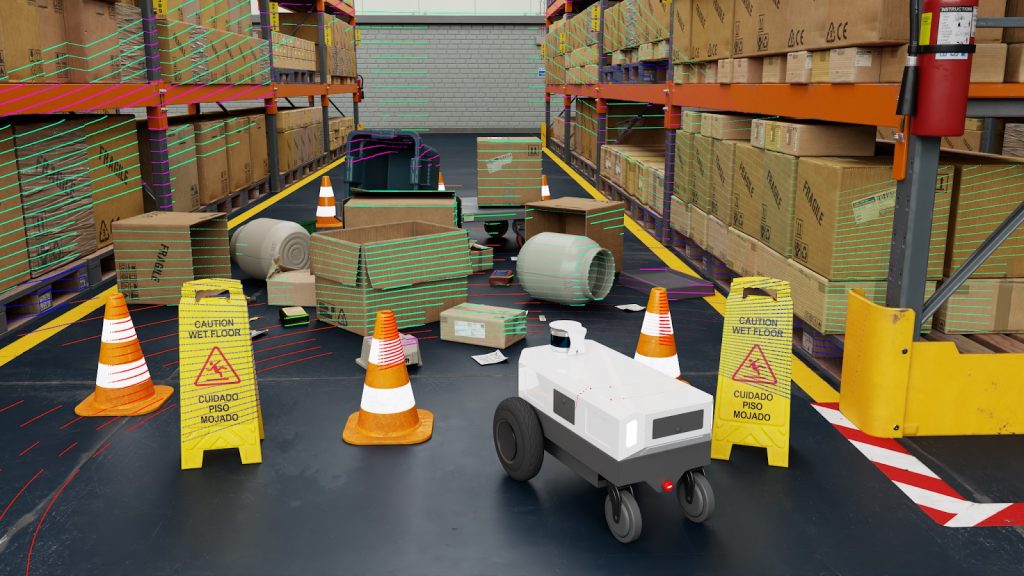
Amit Goel, Director of Product Management for Autonomous Machines at NVIDIA, discusses the new collaboration between Open Robotics and NVIDIA. The collaboration will improve the way ROS and NVIDIA’s line of products such as Isaac SIM and the Jetson line of embedded boards operate together.

NVIDIA’s Isaac SIM lets developers build robust and scalable simulations. Dramatically reducing the costs of capturing real-world data and speeding up development time.

Their Jetson line of embedded boards is core to many robotics architectures, leveraging hardware-optimized chips for machine learning, computer vision, video processing, and more.

The improvements to ROS will allow robotics companies to better utilize the available computational power, while still developing on the robotics-centric platform familiar to many.

For the developers out there, check out the ISAAC ROS Github repository to implement this yourself.

Amit Goel
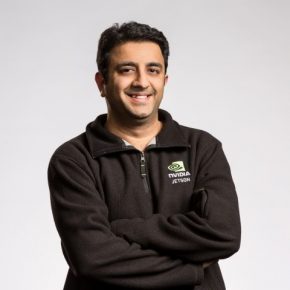
Amit Goel is Director of Product Management for Autonomous Machines at NVIDIA, where he leads the product development of NVIDIA Jetson, the most advanced platform for AI computing at the edge.

Amit has more than 15 years of experience in the technology industry working in both software and hardware design roles. Prior to joining NVIDIA in 2011, he worked as a senior software engineer at Synopsys, where he developed algorithms for statistical performance modeling of digital designs.

Amit holds a Bachelor of Engineering in electronics and communication from Delhi College of Engineering, a Master of Science in electrical engineering from Arizona State University, and an MBA from the University of California at Berkeley.

Links


tags: , , , , , , , , ,


Abate De Mey Podcast Leader and Robotics Founder

            AUAI is supported by:


Subscribe to Robohub newsletter on substack


Related posts :

How to teach the same skill to different robots

  11 May 2026
A new framework to teach a skill to robots with different mechanical designs, allowing them to carry out the same task without rewriting code for each.

Robot Talk Episode 155 – Making aerial robots smarter, with Melissa Greeff

  08 May 2026
In the latest episode of the Robot Talk podcast, Claire chatted to Melissa Greeff from Queen's University about autonomous navigation and learning for drones.

New understanding of insect flight points way to stable flapping-wing robots

  07 May 2026
The way bugs and birds flap their wings may look effortless, but the dynamics that keep them aloft are dizzyingly complex and difficult to quantify.

Robotically assembled building blocks could make construction more efficient and sustainable

  05 May 2026
Research suggests constructing a simple building from interlocking subunits should be mechanically feasible and have a much smaller carbon footprint.

Robot Talk Episode 154 – Visual navigation in insects and robots, with Andrew Philippides

  01 May 2026
In the latest episode of the Robot Talk podcast, Claire chatted to Andrew Philippides from the University of Sussex about what we can learn from ants and bees to improve robot navigation.

Ultralightweight sonar plus AI lets tiny drones navigate like bats

  29 Apr 2026
Researchers develop ultrasound-based perception system inspired by bat echolocation.

Gradient-based planning for world models at longer horizons

  28 Apr 2026
What were the problems that motivated this project and what was the approach to address them?

Robot Talk Episode 153 – Origami-inspired robots, with Chenying Liu

  24 Apr 2026
In the latest episode of the Robot Talk podcast, Claire chatted to Chenying Liu from University of Oxford about how a robot's physical form can actively contribute to sensing, processing, decision-making, and movement.


AUAI is supported by:


Subscribe to Robohub newsletter on substack


©2026.02 - Association for the Understanding of Artificial Intelligence