Robohub.org
ep.

320

podcast
 

Planetary Drilling with Kris Zacny


by
07 October 2020


share this:


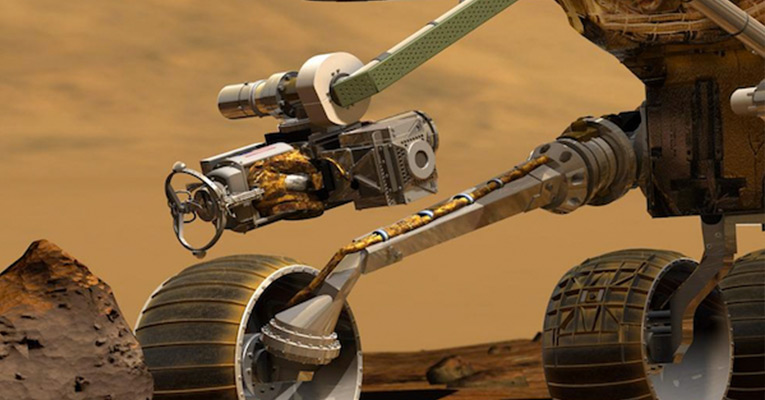
In this episode, Lilly Clark interviews Kris Zacny, the Vice President of Exploration Technologies at Honeybee Robotics.  They discuss two focuses of development at Honeybee: technology for finding extinct extraterrestrial life and technology for in-situ resource utilization. Zacny speaks about the design and operation of current flight projects, and why drilling technology is key to these missions.

Kris Zacny

Dr. Kris Zacny is VP and Senior Research Scientist at Honeybee Robotics. His interests include space mining, sample handling, soil and rock mechanics, extraterrestrial drilling, and In Situ Resource Utilization (ISRU). He co-founded Exploration Technology Division (EX), based in Altadena, CA. EX, with over 100 employees, focuses on developing space mining robots.

In his previous capacity as an engineer in South African underground gold, diamond, and coal mines, Dr. Zacny managed numerous mining projects and production divisions. This hands-on experience related to drilling and mining became invaluable in developing such technologies for space. Dr. Zacny received his PhD (UC Berkeley, 2005) in Geotechnical Engineering with an emphasis on Extraterrestrial Drilling and Mining, ME (UC Berkeley, 2001) in Petroleum Engineering with emphasis on Drilling and Materials Science, and BSc cum laude (U. Cape Town, 1997) in Mechanical Engineering. He participated in several Antarctic, Arctic, Atacama, and Greenland expeditions. Dr Zacny has approx. 200 publications, he has been a PI/Co-I on approx. 50 projects, he has over 40 NASA New Technology Records and four NASA Group Achievement Awards.

Links


tags: ,


Lilly Clark


Subscribe to Robohub newsletter on substack


Related posts :

A multi-armed robot for assisting with agricultural tasks

  18 Mar 2026
How can a robot safely manipulate branches to reveal hidden flowers while remaining aware of interaction forces and minimizing damage?

Graphene-based sensor to improve robot touch

  16 Mar 2026
Multiscale-structured miniaturized 3D force sensors for improved robot touch.

Robot Talk Episode 148 – Ethical robot behaviour, with Alan Winfield

  13 Mar 2026
In the latest episode of the Robot Talk podcast, Claire chatted to Alan Winfield from the University of the West of England about developing new standards for ethics and transparency in robotics.

Coding for underwater robotics

  12 Mar 2026
Lincoln Laboratory intern Ivy Mahncke developed and tested algorithms to help human divers and robots navigate underwater.

Restoring surgeons’ sense of touch with robotic fingertips

  10 Mar 2026
Researchers are developing robotic “fingertips” that could give surgeons back their sense of touch during minimally invasive and robotic operations.

Robot Talk Episode 147 – Miniature living robots, with Maria Guix

  06 Mar 2026
In the latest episode of the Robot Talk podcast, Claire chatted to Maria Guix from the University of Barcelona about combining electronics and biology to create biohybrid robots with emergent properties.

Developing an optical tactile sensor for tracking head motion during radiotherapy: an interview with Bhoomika Gandhi

  05 Mar 2026
Bhoomika Gandhi discusses her work on an optical sensor for medical robotics applications.

Humanoid home robots are on the market – but do we really want them?

  03 Mar 2026
Last year, Norwegian-US tech company 1X announced “the world’s first consumer-ready humanoid robot designed to transform life at home”.


Robohub is supported by:


Subscribe to Robohub newsletter on substack


©2026.02 - Association for the Understanding of Artificial Intelligence