Robohub.org
 

Quadrocopters learn from prior experience to improve slalom flying

by
11 June 2013


share this:
QuadrotorSlalomLearningPriorExperienceSmall

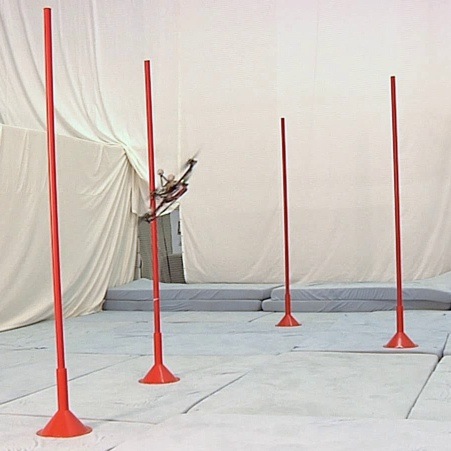
A new video released today by researchers from the Flying Machine Arena shows how a quadrocopter is able to learn from prior experience to improve future performance.

This new research is an extension of results published last year by the same group, which show how quadrocopters can learn to fly high-performance slalom courses (video).

Much like humans learn through repetition and practice, the quadrocopter repeatedly flies the slalom course, records any errors made and then tries to compensate for these errors during the next attempt.

However unlike human-skill-learning, the experience gained by flying one slalom course, was not carried over to a new course – these had to be learned from a state of zero experience.

A new video released by the group today (embedded below), extends this research and enables the quadrocopter to learn from prior experience.

By using knowledge of previously flown slalom courses, the quadrocopter is able to improve its performance on unseen courses, to the point where they can be accurately flown the first time, without practice.

Full Disclosure: I am the lead author of the video and associated research.


tags: , , , , ,


Mike Hamer


Related posts :


Robots to navigate hiking trails

  12 Jan 2026
Find out more about work presented at IROS 2025 on autonomous hiking trail navigation via semantic segmentation and geometric analysis.

Robot Talk Episode 139 – Advanced robot hearing, with Christine Evers

  09 Jan 2026
In the latest episode of the Robot Talk podcast, Claire chatted to Christine Evers from University of Southampton about helping robots understand the world around them through sound.

Meet the AI-powered robotic dog ready to help with emergency response

  07 Jan 2026
Built by Texas A&M engineering students, this four-legged robot could be a powerful ally in search-and-rescue missions.

MIT engineers design an aerial microrobot that can fly as fast as a bumblebee

  31 Dec 2025
With insect-like speed and agility, the tiny robot could someday aid in search-and-rescue missions.

Robohub highlights 2025

  29 Dec 2025
We take a look back at some of the interesting blog posts, interviews and podcasts that we've published over the course of the year.

The science of human touch – and why it’s so hard to replicate in robots

  24 Dec 2025
Trying to give robots a sense of touch forces us to confront just how astonishingly sophisticated human touch really is.

Bio-hybrid robots turn food waste into functional machines

  22 Dec 2025
EPFL scientists have integrated discarded crustacean shells into robotic devices, leveraging the strength and flexibility of natural materials for robotic applications.

Robot Talk Episode 138 – Robots in the environment, with Stefano Mintchev

  19 Dec 2025
In the latest episode of the Robot Talk podcast, Claire chatted to Stefano Mintchev from ETH Zürich about robots to explore and monitor the natural environment.


Robohub is supported by:


Would you like to learn how to tell impactful stories about your robot or AI system?


scicomm
training the next generation of science communicators in robotics & AI


©2025.05 - Association for the Understanding of Artificial Intelligence