Robohub.org
ep.

241

podcast
 

Tensegrity Control with Kostas Bekris

by
18 August 2017


share this:


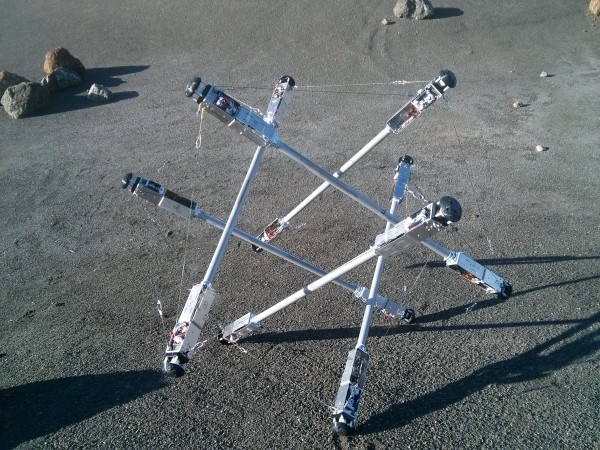
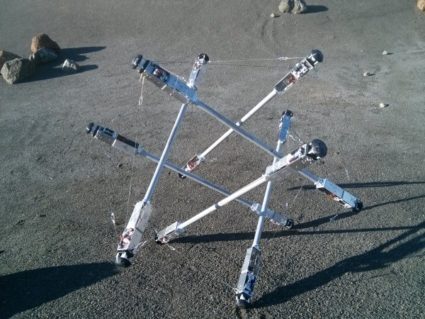
In this episode, Jack Rasiel speaks with Kostas Bekris, who introduces us to tensegrity robotics: a striking robotic design which straddles the boundary between hard and soft robotics. A structure uses tensegrity if it is made of a number of isolated rigid elements which are held in compression by a network of elements that are in tension. Bekris, an Associate Professor of Computer Science, draws from a diverse set of problems to find innovative new ways to control tensegrity robots.

Kostas Bekris

Kostas Bekris, Associate Professor of Computer Science at Rutgers University

Kostas Bekris is an Associate Professor of Computer Science at Rutgers, the State University of New Jersey. He is working in the area of algorithmic robotics, especially on problems related to robot motion planning and coordination. He received his PhD from Rice University in 2008 under the guidance of Lydia Kavraki. He was an Assistant Professor at the University of Nevada, Reno until 2012. His research has been supported by NSF, NASA, the DoD and DHS, including an NASA Early Career Faculty award.


Links:


tags:


Jack Rasiel

            AUAI is supported by:


Subscribe to Robohub newsletter on substack


Related posts :

Robotics roadmaps from around the world

We embark on a tour into some of the recent and prominent robotics roadmaps from around the world.

A ‘5-in-1’ seed-sized surgical robot

Mini robot can move, cut tissue, release drugs, grip and store samples, and generate heat wirelessly

AI agents create virtual playgrounds to help robots get crucial training data

  07 Aug 2026
“SceneSmith” system uses collaborative AI agents to create realistic 3D environments of places like kitchens, hotels, and living rooms, where robots can simulate everyday chores.

Robots in society, business and culture: July 2026

A round up of robotics stories in a new monthly series from IEEE RAS.

Simulated zebrafish and a vision-equipped robotic fish reveal how the body shapes brain circuits

Researchers look to the fish brain to create a robotic zebrafish that can autonomously swim upstream.

Researchers develop modular nanorobot

  31 Jul 2026
A team at the University of Basel has developed a versatile nanorobot with propulsion and payload modules.

Surviving the paper deluge: a one-year study in learning from demonstration

With the explosion of robotics research, staying current in fields like Learning from Demonstration is a monumental challenge.

Soft robotic heart offers new way to study disease and test life-saving devices

Researchers have developed a soft robotic model of the human heart that can mimic disease and provide a realistic environment for testing the next generation of cardiac devices.


AUAI is supported by:


Subscribe to Robohub newsletter on substack


©2026.05 - Association for the Understanding of Artificial Intelligence