
Robohub.org
Housework 2.0: The battle of the robot vacuum cleaners begins!
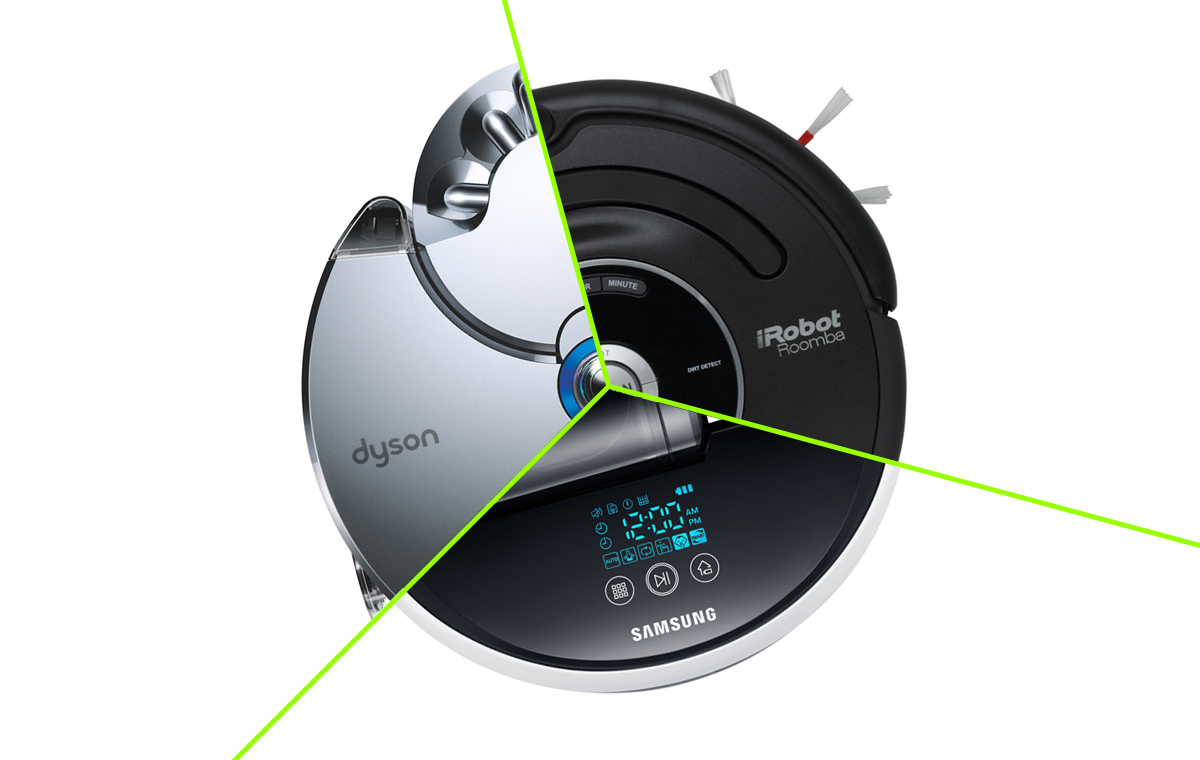
The public may be expecting to see robot cyborgs battle it out in distant galaxies, but back here on earth the battle of the robots is taking on a distinctively quotidian reality. The double announcements today of Dyson’s 360 Eye and Samsung’s Powerbot VR9000 come as a challenge to robot vacuum market leader iRobot’s Roomba, and hails the arrival of a new competitive era of the robot-as-appliance .
http://youtu.be/OadhuICDAjk
While Dyson is a relative giant on the appliance scene, and Samsung is an electronic powerhouse in its own right, Roomba currently boasts dominance in the more niche robot vacuum market. In a recent report, iRobot claims to have sold over 10 million robot vacuum cleaners since 2002, and counts more than 50 countries in its distribution network.
With those figures in mind, it’s no wonder that iRobot responded to today’s announcement of the 360 Eye in lock step with a video riposte that subtly pokes at Dyson for its appliance-based roots:
http://youtu.be/SYm4oLyHpCA
While the video suggests that iRobot’s advantage is that it has always been a robot company (their YouTube description says: “We’ve always believed certain tasks are better left to a robot”), it’s ironic that iRobot only started to make money once it realized that people didn’t want to buy robots as much as they wanted to buy appliances. As iRobot CEO Colin Angle has been quoted as saying:
It took me becoming a vacuum cleaner salesman to actually have some success for my company, my investors and myself.
Andra Keay from Silicon Valley Robotic comments on how tough it can be for a high-tech startup to break into the more traditional appliance market: “iRobot didn’t really start making money until they embraced online sales; the established appliance market was too tough to make a big dent in. Yet they’ve now become the most widely distributed robot in the world.”
Is there room for two more robot vacuums in what many have previously thought of as a novelty market? Or is the “novelty” market now becoming mainstream?
Clearly Dyson and Samsung have done their homework, or they wouldn’t have launched competing products. And with Dyson investing £5m in a lab at Imperial College London, they obviously have their longterm sights set on the robotics community.
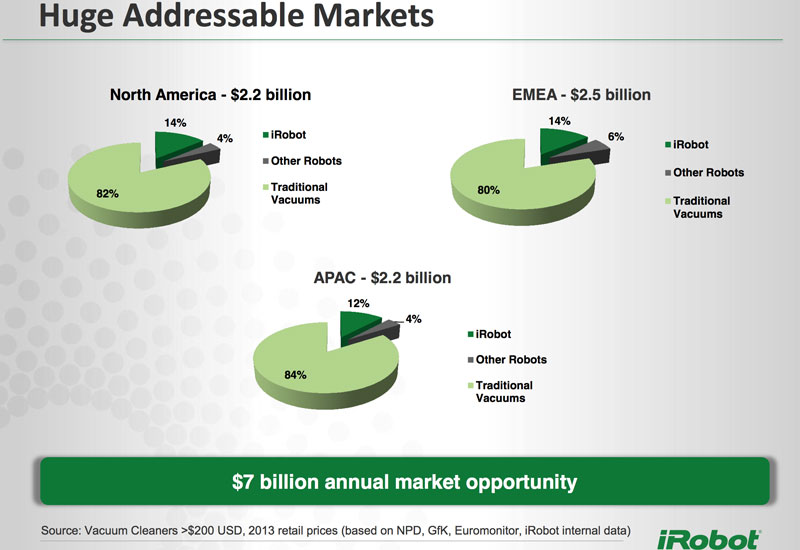
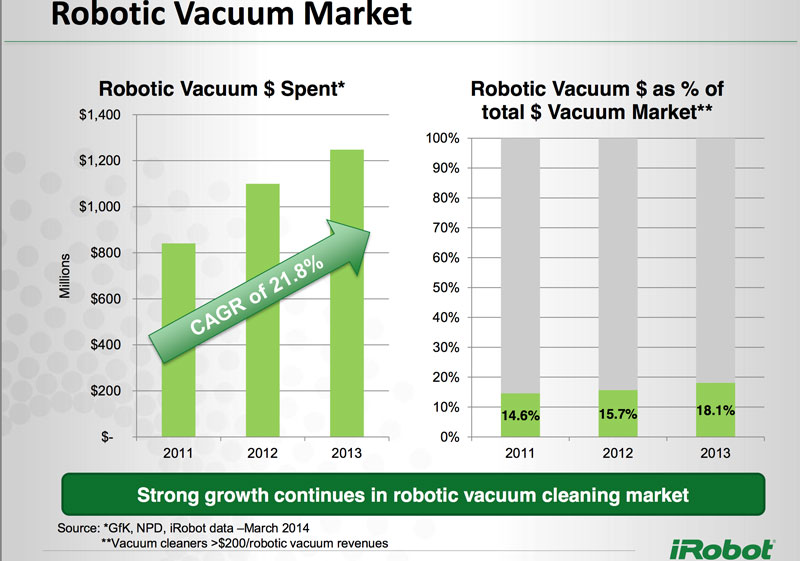
iRobot has been doing its own market research, too. In the above-mentioned report, iRobot claims that the robot vacuum business is at an explosion point, with a “huge addressable market” and a “$7 billion annual market opportunity”. With those kinds of numbers, it’s no wonder that other players are jumping into the game.
Which company is likely to emerge victorious in this battle for the consumers pocketbook? It may be too early to tell. Keay says that “Dyson is definitely upping the ante though with a smart phone connected vacuum cleaner. And with Dyson’s distribution networks and reputation, it will be interesting to see how the public adopts Housework 2.0.”
One thing is for certain, though: competition is a sure sign of growth in this space.
With contributions by Yannis Erripis, Andra Keay, John Payne, and Frank Tobe.
If you liked this article, you may also be interested in:
- Why is Japan the first to get Dyson’s new 360 Eye?
- Recent robotic vacuum launches change industry from niche to mainstream
- Has Dyson’s robotic dream become reality?
- Dyson launches new robotic vacuum cleaner
- Dyson invests £5m in robot lab
See all the latest robotics news on Robohub, or sign up for our weekly newsletter.
tags: c-Consumer-Household, consumer robotics, cx-Business-Finance, Dyson, iRobot, roomba, Samsung, Service Household Vacuum

AUAI is supported by:









