Robohub.org
ep.

164

podcast
 

M-Blocks with John Romanishin

MIT         

by
05 September 2014


share this:


M-Blocks

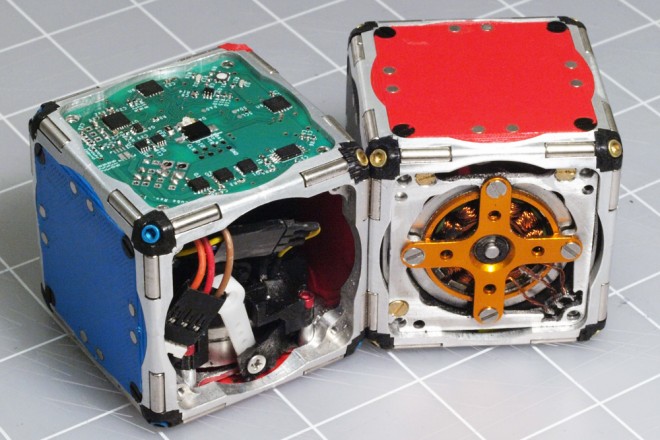
In this episode, Audrow Nash interviews John Romanishin from MIT, about his modular robotics project ‘M-Blocks’. M-Blocks are small cubes (5 cm on a side) that have no external actuators, yet they manage to move and even jump. They do this by rotating an internal mass at high speeds then stopping that mass suddenly, which transfers inertia to the cube causing it to move. The rotating mass can change which plane it’s spinning in, allowing the cube to move in any direction.  By combining this inertial actuator with permanent magnets, M-Blocks can move over similar robots (or more M-Blocks) and precisely line up. The future of this project is best put by John, who says, “We want hundreds of cubes, scattered randomly across the floor, to be able to identify each other, coalesce, and autonomously transform into a chair, or a ladder, or a desk, on demand.” 

JohnRomanishin

John Romanishin
John Romanishin is currently a graduate student studying mechanical engineering and researching self-reconfigurable modular robots at the Distributed Robotics Laboratory led by Daniela Rus at MIT.

Links:


tags: ,


Audrow Nash is a Software Engineer at Open Robotics and the host of the Sense Think Act Podcast

            AUAI is supported by:


Subscribe to Robohub newsletter on substack


Related posts :

Exploring the Moon will require rovers that can think for themselves – an upcoming NASA mission will test whether they can

  04 Sep 2026
NASA is planning to send three small rovers to the Moon to autonomously compute how to best explore a patch of ground.

Surviving the paper deluge: Notes from an ICRA panel on publishing, LLMs, and the future of peer review

Experts discuss peer-review challenges and possibilities for reshaping the process.

When expressive humanoid robots are awkward, people become wary – new brain study

  31 Aug 2026
People become more suspicious of a humanoid robot that makes errors, especially when the robot is an expressive conversation partner.

First 11 vs 11 humanoid soccer game played at RoboCup 2026

  28 Aug 2026
Watch highlights from this historic match.

How green is your robot? And other awkward questions

Robots clean rivers and sort waste, monitor ecosystems, and inspect renewable-energy infrastructure. But even the greenest robot has an environmental footprint.

These tiny drones are powered by sound

  24 Aug 2026
EPFL engineers have designed acoustic cavities that convert sound waves into thrust, propelling small robots and ultralight aerial vehicles without on-board actuators or electronics.

#AAMAS2026 blue sky award winner: Foundation world models for agents in changing environments

and   21 Aug 2026
Hear from the AAMAS 2026 Best Blue Sky Paper Award winner.

Robotics roadmaps from around the world spotlight of the month: Japan

Robots have been a prolific theme in Japanese pop culture and media since the 1950s


AUAI is supported by:


Subscribe to Robohub newsletter on substack


©2026.05 - Association for the Understanding of Artificial Intelligence