Robohub.org
 

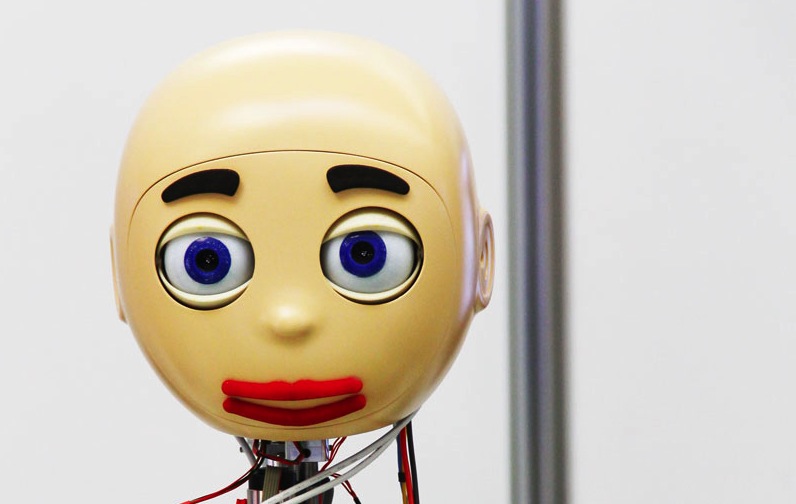
Do robots need heads?


by
15 August 2013


share this:

Robohub.org - robot_facial_expressionsRobots are machines and most people agree that they primarily serve a utilitarian purpose. So why do so many of them have heads? Here are some thoughts by AJung Moon, Mark Stephen Meadows, Travis Deyle, and David Robert.



AJung Moon
AJung Moon on “Do robots need heads?”

Are you curious about what your future robotic assistants will look like? My bet is that by the time you buy your very first robotic butler, it will have a friendly head on it that moves. In fact, it would be a good idea to make robots with heads if they are intended to share spaces and objects with people. That’s because …

Read more →


Mark Stephen Meadows
Mark Stephen Meadows on “Do robots need heads?”

I don’t know about you, but if something has a head I assume it has thoughts. When watching a movie I stare at the character’s face because I want to know what they feel. So for me a head’s a pretty important thing. If I’m going to talk with a robot, …

Read more →


Travis Deyle
Travis Deyle on “Do robots need heads?”

The obvious answer to this question is “No: there are lots of robots without heads.” It’s not even clear that social robots necessarily require a head, …

Read more →


David Robert
David Robert on “Do robots need heads?”

As a robot animator I can attest to the fact that robots don’t “need” heads to be treated as social entities. Research has shown that people will befriend a stick as long as it moves properly. We have a long-standing habit of anthropomorphizing things that aren’t human by attributing to them human-level personality traits or internal motivations based on cognitive-affective architectures that just aren’t there. …

Read more →


tags: , ,


RBI Editors

            AUAI is supported by:


Subscribe to Robohub newsletter on substack


Related posts :

Developing active and flexible microrobots

  13 May 2026
This class of robots opens up possibilities for biomedical applications.

How to teach the same skill to different robots

  11 May 2026
A new framework to teach a skill to robots with different mechanical designs, allowing them to carry out the same task without rewriting code for each.

Robot Talk Episode 155 – Making aerial robots smarter, with Melissa Greeff

  08 May 2026
In the latest episode of the Robot Talk podcast, Claire chatted to Melissa Greeff from Queen's University about autonomous navigation and learning for drones.

New understanding of insect flight points way to stable flapping-wing robots

  07 May 2026
The way bugs and birds flap their wings may look effortless, but the dynamics that keep them aloft are dizzyingly complex and difficult to quantify.

Robotically assembled building blocks could make construction more efficient and sustainable

  05 May 2026
Research suggests constructing a simple building from interlocking subunits should be mechanically feasible and have a much smaller carbon footprint.

Robot Talk Episode 154 – Visual navigation in insects and robots, with Andrew Philippides

  01 May 2026
In the latest episode of the Robot Talk podcast, Claire chatted to Andrew Philippides from the University of Sussex about what we can learn from ants and bees to improve robot navigation.

Ultralightweight sonar plus AI lets tiny drones navigate like bats

  29 Apr 2026
Researchers develop ultrasound-based perception system inspired by bat echolocation.

Gradient-based planning for world models at longer horizons

  28 Apr 2026
What were the problems that motivated this project and what was the approach to address them?


AUAI is supported by:


Subscribe to Robohub newsletter on substack


©2026.02 - Association for the Understanding of Artificial Intelligence