Robohub.org
ep.

223

podcast
 

Actuation for Robotic Fingers with Edward Neff

by
11 December 2016


share this:


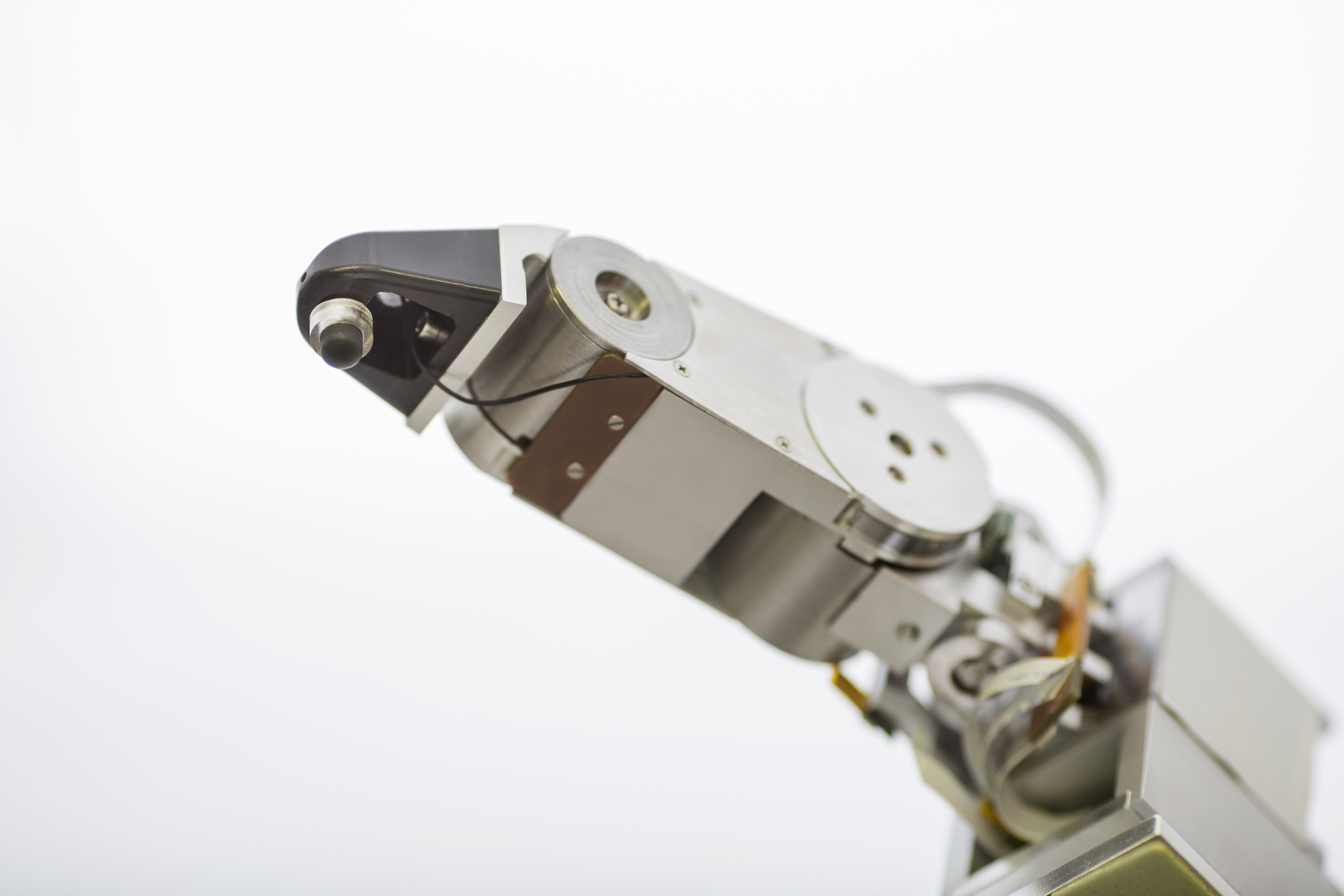
smac_robotic_finger_smaller

In this episode, Abate De Mey interviews Edward Neff, founder of SMAC Corporation. Mr. Neff discusses how breakthroughs in his company have allowed them to develop linear actuators compact enough to be used to actuate robotic fingers. Companies like Apple and Samsung push for the development of robotic fingers to perform lifelike tests on their phones.

The robotic fingers developed using SMAC’s linear servo motors simulate a button press on a screen by employing a strong downwards force, as well as small sideways forces tangential to the screen. This mimics a realistic way that people interact with their touchscreens. The robotic fingers can also gently bump into surfaces, pull, and push objects. Other applications for these fingers include electronic circuit board assembly, and screwing bottle caps onto bottles.

Edward Neff

edward-neff
Edward Neff grew up in Birmingham, Michigan (USA) and is a graduate of the University of Michigan. He has a career history of managing automation companies in Belgium and Japan. Mr. Neff is the founder of SMAC Corporation in Carlsbad, California. SMAC is a leading manufacturer of precision programmable electric actuators. The company is planning a 2018 IPO. Mr Neff has over 40 patents in robotics and serves as a Director in BioTech and Medical Device companies.

Links


tags: , , , , , , , ,


Abate De Mey Podcast Leader and Robotics Founder

            AUAI is supported by:


Subscribe to Robohub newsletter on substack


Related posts :

Developing active and flexible microrobots

  13 May 2026
This class of robots opens up possibilities for biomedical applications.

How to teach the same skill to different robots

  11 May 2026
A new framework to teach a skill to robots with different mechanical designs, allowing them to carry out the same task without rewriting code for each.

Robot Talk Episode 155 – Making aerial robots smarter, with Melissa Greeff

  08 May 2026
In the latest episode of the Robot Talk podcast, Claire chatted to Melissa Greeff from Queen's University about autonomous navigation and learning for drones.

New understanding of insect flight points way to stable flapping-wing robots

  07 May 2026
The way bugs and birds flap their wings may look effortless, but the dynamics that keep them aloft are dizzyingly complex and difficult to quantify.

Robotically assembled building blocks could make construction more efficient and sustainable

  05 May 2026
Research suggests constructing a simple building from interlocking subunits should be mechanically feasible and have a much smaller carbon footprint.

Robot Talk Episode 154 – Visual navigation in insects and robots, with Andrew Philippides

  01 May 2026
In the latest episode of the Robot Talk podcast, Claire chatted to Andrew Philippides from the University of Sussex about what we can learn from ants and bees to improve robot navigation.

Ultralightweight sonar plus AI lets tiny drones navigate like bats

  29 Apr 2026
Researchers develop ultrasound-based perception system inspired by bat echolocation.

Gradient-based planning for world models at longer horizons

  28 Apr 2026
What were the problems that motivated this project and what was the approach to address them?


AUAI is supported by:


Subscribe to Robohub newsletter on substack


©2026.02 - Association for the Understanding of Artificial Intelligence