Robohub.org
ep.

219

podcast
 

ICRA 2016: Landmine Detection Challenge with Edson Prestes

by
16 October 2016


share this:


img_0031

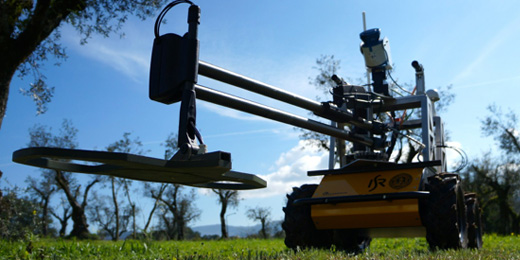
In this episode, Audrow Nash interviews Edson Prestes, Professor at Federal University of Rio Grande do Sul and an organizer of the Humanitarian Robotics and Automation Technology Challenge (HRATC) 2016 competition. The HRATC competition challenges teams around the world to develop methods of controlling robots to detect land mines in large open environments.

According to the UN Mine Action Service, landmines kill 15,000–20,000 people every year (mostly children) and maim countless more across 78 countries. Demining efforts cost US 300–1000 USD per mine, and, for every 5000 mines cleared, one person is killed and two are injured. Thus, clearing post-combat regions of landmines has proven to be a difficult, risky, dangerous and expensive task with enormous social implications for civilians.


Edson Prestes

Edson Prestes received his B.Sc. degree in Computer Science(CS) from the Federal University of Pará (UFPa), Brazil, in 1996 and M.Sc. and Ph.D. in CS from the Federal University of Rio Grande do Sul (UFRGS), Brazil, in 1999 and 2003, respectively. He is a CNPq Productivity Fellow (Brazilian National Council for Scientific and Technological Development) for his contribution to Brazilian Scientific Progress. Edson is Professor at UFRGS, since 2005, and Head of ϕ-Robotics Research Group.

Links


tags: , , , , , ,


Audrow Nash is a Software Engineer at Open Robotics and the host of the Sense Think Act Podcast

            AUAI is supported by:


Subscribe to Robohub newsletter on substack


Related posts :

AI brings object-level vision prosthetics closer to reality

  23 Jun 2026
Researchers are developing AI models that could one day enable vision prosthetics able to restore meaningful, object-level sight for the blind.

AURA Foresight Reaches Global XPRIZE Wildfire Finals in Alaska

  19 Jun 2026
One of only four teams remaining from more than 130 competitors worldwide, our team AURA Foresight is developing autonomous technology to stop wildfires before they grow out of control. AURA Foresi...

Robot Talk Episode 161 – Collaborative haptic systems, with Allison Okamura

  19 Jun 2026
In the latest episode of the Robot Talk podcast, Claire chatted to Allison Okamura from Stanford University about developing advanced robotic systems for haptic (touch) interaction.

New research enables a robot to chart a better course

  17 Jun 2026
By rapidly generating a smooth path plan that cuts travel time and avoids obstacles, the open-source “MIGHTY” system could streamline disaster recovery and parcel delivery.

Entangled robotic matter with cohesive motion

  15 Jun 2026
Engineers have developed a robotic collective that behaves less like a machine and more like a material that flows.

Robot Talk Episode 160 – Robotic blacksmiths, with Edward Mehr

  12 Jun 2026
In the latest episode of the Robot Talk podcast, Claire chatted to Edward Mehr from Machina Labs about their RoboCraftsman that shapes complex metal parts for the aerospace, defence, and automotive industries.

Congratulations to the #AAMAS2026 best paper award winners

  08 Jun 2026
Find out who won in the categories of best paper, best student paper, and best blue sky paper.

Robot Talk Episode 159 – Robot sensing and manipulation, with Maria Koskinopoulou

  05 Jun 2026
In the latest episode of the Robot Talk podcast, Claire chatted to Maria Koskinopoulou from Heriot-Watt University about autonomous robotic manipulators for surgery, industry, and beyond.


AUAI is supported by:


Subscribe to Robohub newsletter on substack


©2026.05 - Association for the Understanding of Artificial Intelligence