
Robohub.org
40% annual growth forecast for Chinese robotics
 Song Xiaogang, president of CRIA, China’s Robotics Industry Association, said that the number of robots sold in China in 2014 would reach 50,000; up from 36,860 in 2013.
“From now on, the robot industry will maintain an annual growth rate of 40% for a long period of time,” he said. “China has already overtaken Japan as the world’s largest consumer of robots, buying more than one-fifth of the world’s robot output.”
The rapid growth has encouraged Chinese companies to enter the market of making robots. By the end of October, China had more than 430 companies manufacturing components, vision and motion systems, sensors, or complete robots of one type or another said Song. An average of two new companies joins the sector every week according to The Star, an Indonesian newspaper and website.
“Apart from robotic workers in manufacturing industries, which account for most robot applications in China, there is a growing demand for self-driving cars, delivery drones and even robot journalists by 2030,” said Song.
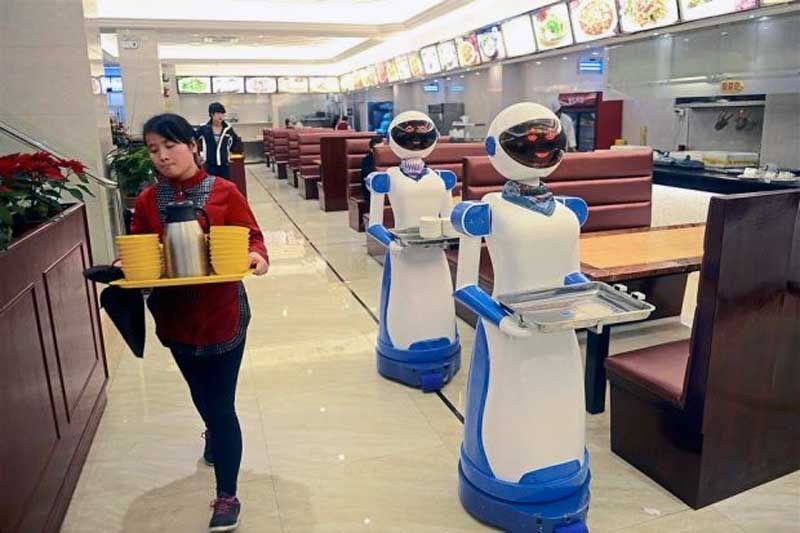
 In order to offset rising labor costs and a shortage of skilled workers – major problems plaguing China – robots are beginning to be deployed for many different uses, mostly in industrial settings, but as the photo of the restaurant robots above shows, in service roles as well. The photo is of a newly opened restaurant in Cixi which has introduced two server robots which help deliver food, collect empty dishes as well as offer menu selections.
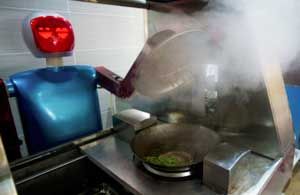
According to the All-China Women’s Federation, the recent flurry of restaurants using robots for waiters, busing tables, noodle cutting, and food preparation, threatens jobs held by women.
This, of course, is not just a Chinese phenomena. In October, Oxford University published a study of the application of robotics in the US labor force. It found that it is possible that as much as 47% of the current labor force could be replaced with robots over the next two decades.
tags: business, China, CRIA, service robotics

AUAI is supported by:









