Robohub.org
Japan looks to distributed, cooperative control to help manage energy market deregulation
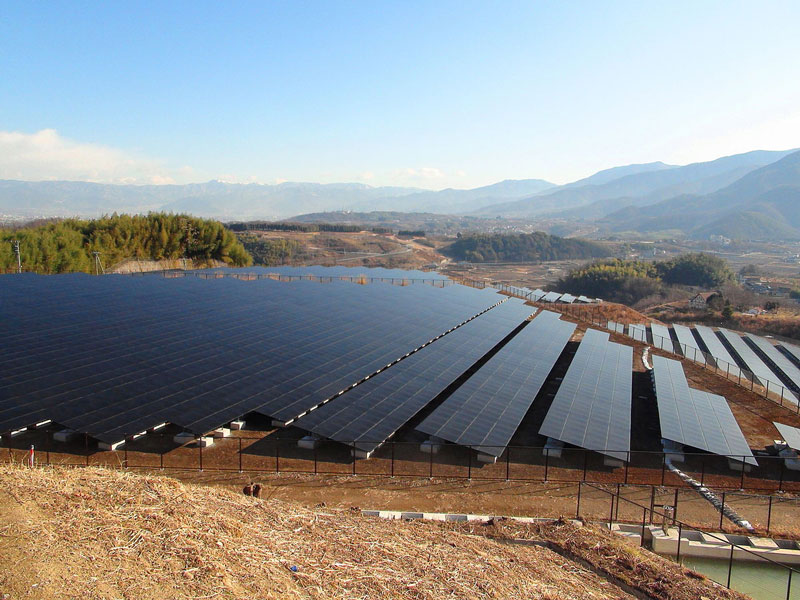
Komekurayama Solar Power Plant owned and operated by TEPCO in Kofu, Yamanashi Prefecture. Source: Sakaori via Wikimedia Commons.
Japan’s power industry is currently centralized, but it aims to deregulate by around 2020. Coupled with this major structural market change, the expansion of thermal, nuclear and renewable power generation will place additional demands on the management of the country’s energy market. Researchers from the Namerikawa lab at Keio University are working with control engineers, power engineers and economists to designing mechanical and control algorithms that can manage this large-scale problem.
The Namerikawa Laboratory of the Department of System Design Engineering in the Keio University Faculty of Science and Technology is conducting theoretical research of distributed control and cooperative control, as well as research concerning social applications in network systems thereof. As applied research, the Namerikawa Lab is conducting world-leading research in the areas of distributed and cooperative control of large-scale, complex systems connected to a network, formation control of unmanned aerial vehicles, and energy management of power networks.
“Since the earthquake and tsunami disaster of March 11, 2011, energy has become an extremely important issue that now involves the problems of nuclear power generation and the use of renewable energy. With all these areas, we no longer have centralized management by power companies as we did in the past, and instead, various companies can now supply energy. In addition, we also now have the option of selecting the company that is best suited for our needs from amongst various energy companies. Hence distributed management is becoming a key issue. “
Japan is aiming to deregulate the power industry by sometime around the year 2020, and with this deregulation, the power network is expected to become extremely complex. In the past, information was consolidated and managed based on centralized management, but after deregulation, it will be necessary to analyze power systems on the demand side and the supply side to ensure stabilized frequency tuning, and an appropriate power market must be created.
Frequency controllers are used to control power generators, and by running the generator itself at a constant rotational speed, we should be able to obtain power with a stable 50 Hz, 100 V supply voltage. However, when we add renewable energy and other power sources to the power network, they act in a form that is like noise, so the first thing that we need to do is implement feedback control with respect to those additional power sources so that a 100 V supply voltage can be continuously maintained at 50 Hz.
In addition to thermal power generation and nuclear power generation, an expansion of renewable energy is also expected to occur in the future. With that expansion, the power supply side will need to implement frequency control in order to maintain a stable supply of power, while the demand side will need to be managed based on a new control theory.
“The second area we need to look at is controlling demand using what is called demand response. Basically, what we want to do is achieve a balance between supply and demand. We want to change the behavior of consumers by changing the price. By doing this, we can shift demand peaks and level out power usage, and as a result, we are basically able to control consumers. This isn’t merely a mechanical and electrical control problem. It also pertains to economic activity, so it is an economic problem and an electric power problem. Trying to figure out how to design the power market in order to deal with these issues has become an extremely large-scale problem, namely a market design problem. When a full deregulation of power transactions has been achieved, there will be a demand to design a power market that is fully capable of supporting this type of deregulation. Therefore, right now we’re working with control engineers, power engineers, researchers, and economists to research new mechanisms for power transactions.”
With consideration of the standpoints of both the power demand side and supply side, the Namerikawa Lab is leading the world in research to develop algorithms to find the most appropriate compromise between the two sides and to quantify satisfaction levels. The lab is also focusing its efforts on research to build sensor agent and multi-agent systems to determine in real time the status of spatially and temporally distributed energy and environments.
“We’re conducting research with a major goal of fusing together this type of energy technology and UAV control technology to achieve optimum management and optimum control of social systems and social infrastructures in the future.”
If you liked this article, you may also be interested in:
- Why is Japan the first to get Dyson’s new 360 Eye?
- Japan’s new robotics push: Funding and deregulation
- Fukushima photo essay: A drone’s eye view
- ShanghAI Lectures: Weidong Chen “Modeling and Control of Mobile Robot Networks”
- The Distributed Flight Array: Modular robots that self-assemble, coordinate and take flight
See all the latest robotics news on Robohub, or sign up for our weekly newsletter.
tags: Algorithm Controls, c-Research-Innovation, cx-Politics-Law-Society, Japan, Keio University