Robohub.org
090
Made in Brazil with Marcelo Becker and Marcel de Sena Dall’Agnol
In today’s show, we take you all the way to Brazil. Marcelo Becker from the University of São Paulo (USP) talks to us about how mobile robots are going to help change agriculture, manufacturing and driving in his country. We then speak with Marcel de Sena Dall’Agnol a student at USP about the excellent robotics competition they organized at SEMATRON, which is a mechatronics conference organized by USP undergraduates.
Marcelo Becker
 Marcelo Becker is Professor at the University of São Paulo, one of the top universities in Brazil. He directs the Mobile Robotics Lab that aims towards real-world applications with potential positive impact. His projects focus on agricultural mobile robots, educational robots, intelligent warehouses forklifts, quadrotors and autonomous cars with partner FIAT. More broadly, Becker discusses the growing interest for robotics in Brazil, public perception and the future of the field.
Before joining USP, Becker was Professor at the Pontifical Catholic University of Minas Gerais (PUC Minas) where he was also the co-head of the Mechatronics Engineering Department and of the Robotics and Automation Group (GEAR). He also was visiting Professor at the Autonomous System Lab (ASL) at the EPFL in 2006.
Marcel de Sena Dall’Agnol
Marcel is a third year student in EECS at the University of Sao Paolo. This year he was one of the organizers of SEMATRON VII, a week-long series of activities directed towards students in Mechatronic Engineering in São Carlos and nearby cities. During the week, students at the University of São Paulo have their lessons suspended in order to fully participate in the event which offers lectures, courses, a cultural activity and technical visits to companies. The event is one of the largest of the kind in Brazil, with around 500 participants. Internationally renowned companies such as FIAT, National Instruments, Embraer and Petrobrás have sponsored the event in past editions.
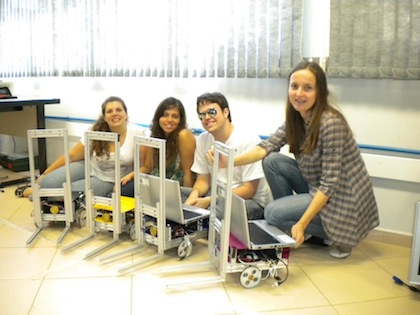
In this interview, we will be talking about one of the main attractions, the robotics competition. During the one-day event, students gather around robotic kits made by local company PNCA. The kits let students build robots from scratch and come with an easy-to-use programming interface. The task this year, inspired from the Fukushima disaster, was to retrieve victims from a nuclear power plant while avoiding hazards.
Links:
- Download mp3 (16.5 MB)
- Subscribe to Robots using iTunes
- Subscribe to Robots using RSS
- Marcelo Becker’s Homepage
tags: agricultural robotics, podcast