
Robohub.org
If death by autonomous car is unavoidable, who should die? Reader poll results
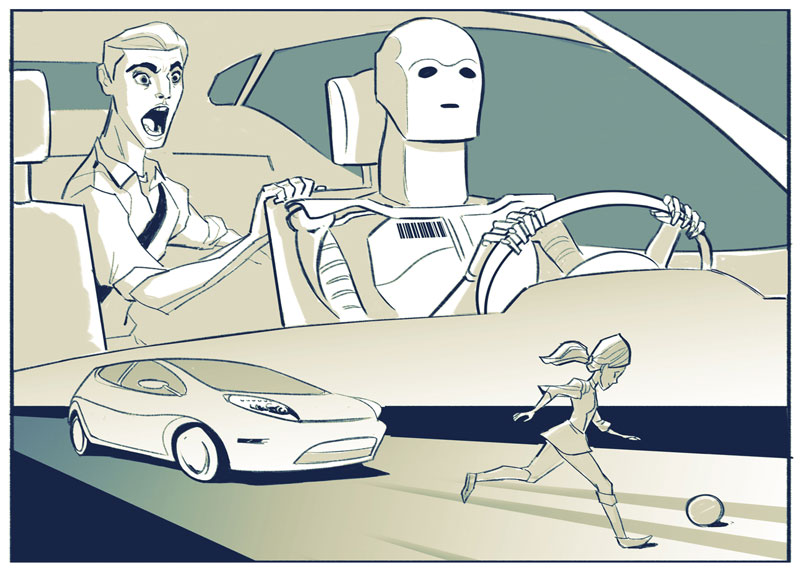
Life and death decisions make interesting thought experiments. When you throw an autonomous car into the mix, things get even more interesting.
A couple of weeks ago Jason Millar wrote about such a scenario called the Tunnel Problem. The Tunnel Problem goes something like this:
The Tunnel Problem: You are travelling along a single lane mountain road in an autonomous car that is approaching a narrow tunnel. You are the only passenger of the car. Just before entering the tunnel a child attempts to run across the road but trips in the center of the lane, effectively blocking the entrance to the tunnel. The car has only two options: continue straight, thereby hitting and killing the child, or swerve, thereby colliding into the wall on either side of the tunnel and killing you.
If you are the passenger in an autonomous car, and you suddenly find yourself facing a tunnel problem as described above, how should the car react? And who should make the call on how the car behaves in such scenarios to begin with?
With the help of Jason Millar, we decided to pose these questions to you. Our reader poll was wildly popular, thanks to all your support. We received responses from over 110 participants, 20 female and 93 male participants, most of whom (43%) are between 25 and 34 years old.
We are very excited to share the results with you here:
If you find yourself as the passenger of the tunnel problem described above, how should the car react?

The Tunnel Problem was set up in such as way that there are only two outcomes: going straight kills the child, whereas swerving kills you. Maybe it’s not that surprising to you that the majority of the participants (64%) said that the car should continue to drive straight and kill the child.
The majority of the participants (64%) said that the car should continue to drive straight and kill the child.
But it was surprising to some of us that 36% of the participants said the car should swerve and kill them instead. Were those cases of altruism? Why would some people choose to save themselves, while quite a significant number of other people choose to save the child?
We knew you’d be curious about this. So, we also asked our participants to tell us reasons for their answer to this question. We collected a very interesting set of responses for both options and we’re currently mulling over the data. Due to time constraints and our interest in getting the analysis done properly, we’ll be posting our analysis of the reasons next week.
How hard was it for you to answer the Tunnel Problem question?

We thought that most people would find the Tunnel Problem quite difficult to answer. It’s an ethical dilemma with no obvious answer after all. But boy, were we surprised. Roughly 48% of respondents said that it was an easy question to answer, whereas 28% and 24% said it was moderately difficult and difficult, respectively.
Roughly 48% of respondents said that it was an easy question to answer, whereas 28% and 24% said it was moderately difficult and difficult, respectively.
More interestingly, the percentage of people easily making the decisions were spread fairly evenly between the two options. A total of 47% of people who believe that autonomous cars should continue straight said that it was an easy question to answer, whereas the percentages were around 51% for those choosing to swerve and kill the passenger.
This is interesting because it implies that people are pretty confident in making a decision on this regardless of whether they believe the car should kill the child or themselves (the passenger). This also could mean that manufacturers, designers, lawmakers, or whoever may be making the decision on how a real Tunnel Problem-like scenario should be handled by autonomous cars probably can’t ignore the opinions of people who would rather have the car to swerve in such scenarios.
So, who should be deciding how the cars should behave in such scenarios anyway?
Who should determine how the car responds?

Most participants told us that either the passenger (44%) or lawmakers (33%) should decide how the car responds to such Tunnel Problem scenarios. This might make things tough for manufacturers or designers, who were supported by only 12% of our participants.
Most participants told us that either the passenger (44%) or lawmakers (33%) should decide how the car responds to such Tunnel Problem scenarios.
While manufacturers are the ones who will be designing and implementing how a car responds to different driving scenarios, including the Tunnel Problem, the design decisions will have to be tightly coupled with other stakeholders of the technology before the technology hits the market — perhaps much more so than they currently are.
Interestingly, while we found a significant support for lawmakers to be the decider of this for people 44 years or younger, none of the people 45 and above supported them.
But why are people saying that the passenger should be making this decision, or the lawmakers over the manufacturers/designers? Are we seeing some effects of distrust to the upcoming technology? We’ll discuss the reasons for people’s answers to this question on our next week’s analysis post.
The result of the poll presented in this post have been analyzed and written by AJung Moon, Jason Millar, Camilla Bassani, Fausto Ferreira, and Shalaleh Rismani, at the Open Roboethics initiative.
If you liked this article, you may also be interested in:
- An ethical dilemma: When robot cars must kill, who should pick the victim?
- Reader poll: If a death by an autonomous car is unavoidable, who should die?
- Should autonomous cars be allowed to speed? Results from our reader poll
- Kids with wheels: Should the unlicensed be allowed to ‘drive’ autonomous cars?
- What should a robot do? Designing robots that know right from wrong
- Morgan Stanley reports on the economic benefits of driverless cars
See all the latest robotics news on Robohub, or sign up for our weekly newsletter.
tags: Automotive, Autonomous Cars, c-Politics-Law-Society, cx-Research-Innovation, machine ethics, reader poll, reader poll: autonomous cars, Report, Robot Car, Social aspect, the Tunnel Problem

AUAI is supported by:









