Robohub.org
 

CoCoRo CeBIT


by
08 October 2014


share this:


CoCoRo CeBIT   YouTube

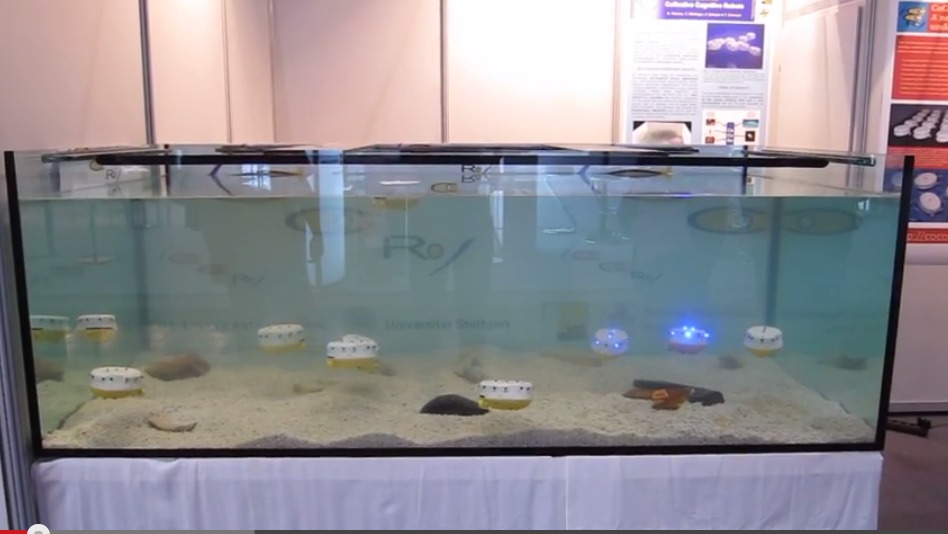
The EU-funded Collective Cognitive Robotics (CoCoRo) project has built a swarm of 41 autonomous underwater vehicles (AUVs) that show collective cognition. Throughout 2015 – The Year of CoCoRo – we will be uploading a new weekly video detailing the latest stage in its development. This video shows the CoCoRo autonomous underwater vehicles (AUVs) in a large aquarium at the CeBIT exhibition, and simulates a real mission scenario in which the AUVs have to collectively find an object of potential interest at the sea floor (e.g., a black box of a crashed plane).

In the beginning the AUVs start randomly distributed in the mission area (= aquarium) where the object is assumed to be. The AUVs do not perform a special search pattern but instead use a simple random walk. Due to the high number of AUVs, quite soon one of the AUVs will be near the object (in this case a magnetic target) and can perceive it.

The AUV then tries to keep its position above the object and starts to emit blue-light signals that attract other nearby AUVs which in turn also emit blue-light signals. This leads to a fast aggregation of most of the swarm AUVs near the object. In future underwater swarms these AUVs could then collectively grab and lift the object to the water surface.

To learn more about the project, see this introductory post, or check out all the videos from the Year of CoCoRo on Robohub.


tags: , , , , , , ,


Thomas Schmickl is an Associate Professor at Karl-Franzens University, Graz, Austria, and a lecturer at the University for Applied Sciences in St. Pölten, Austria.


Subscribe to Robohub newsletter on substack


Related posts :

Robot Talk Episode 145 – Robotics and automation in manufacturing, with Agata Suwala

  20 Feb 2026
In the latest episode of the Robot Talk podcast, Claire chatted to Agata Suwala from the Manufacturing Technology Centre about leveraging robotics to make manufacturing systems more sustainable.

Reversible, detachable robotic hand redefines dexterity

  19 Feb 2026
A robotic hand developed at EPFL has dual-thumbed, reversible-palm design that can detach from its robotic ‘arm’ to reach and grasp multiple objects.

“Robot, make me a chair”

  17 Feb 2026
An AI-driven system lets users design and build simple, multicomponent objects by describing them with words.

Robot Talk Episode 144 – Robot trust in humans, with Samuele Vinanzi

  13 Feb 2026
In the latest episode of the Robot Talk podcast, Claire chatted to Samuele Vinanzi from Sheffield Hallam University about how robots can tell whether to trust or distrust people.

How can robots acquire skills through interactions with the physical world? An interview with Jiaheng Hu

and   12 Feb 2026
Find out more about work published at the Conference on Robot Learning (CoRL).

Sven Koenig wins the 2026 ACM/SIGAI Autonomous Agents Research Award

  10 Feb 2026
Sven honoured for his work on AI planning and search.

Robot Talk Episode 143 – Robots for children, with Elmira Yadollahi

  06 Feb 2026
In the latest episode of the Robot Talk podcast, Claire chatted to Elmira Yadollahi from Lancaster University about how children interact with and relate to robots.

New frontiers in robotics at CES 2026

  03 Feb 2026
Henry Hickson reports on the exciting developments in robotics at Consumer Electronics Show 2026.


Robohub is supported by:


Subscribe to Robohub newsletter on substack


©2026.02 - Association for the Understanding of Artificial Intelligence