Robohub.org
ep.

219

podcast
 

ICRA 2016: Landmine Detection Challenge with Edson Prestes

by
16 October 2016


share this:


img_0031

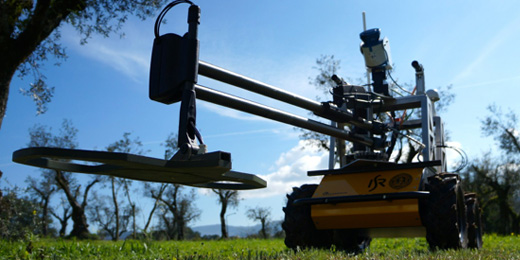
In this episode, Audrow Nash interviews Edson Prestes, Professor at Federal University of Rio Grande do Sul and an organizer of the Humanitarian Robotics and Automation Technology Challenge (HRATC) 2016 competition. The HRATC competition challenges teams around the world to develop methods of controlling robots to detect land mines in large open environments.

According to the UN Mine Action Service, landmines kill 15,000–20,000 people every year (mostly children) and maim countless more across 78 countries. Demining efforts cost US 300–1000 USD per mine, and, for every 5000 mines cleared, one person is killed and two are injured. Thus, clearing post-combat regions of landmines has proven to be a difficult, risky, dangerous and expensive task with enormous social implications for civilians.


Edson Prestes

Edson Prestes received his B.Sc. degree in Computer Science(CS) from the Federal University of Pará (UFPa), Brazil, in 1996 and M.Sc. and Ph.D. in CS from the Federal University of Rio Grande do Sul (UFRGS), Brazil, in 1999 and 2003, respectively. He is a CNPq Productivity Fellow (Brazilian National Council for Scientific and Technological Development) for his contribution to Brazilian Scientific Progress. Edson is Professor at UFRGS, since 2005, and Head of ϕ-Robotics Research Group.

Links


tags: , , , , , ,


Audrow Nash is a Software Engineer at Open Robotics and the host of the Sense Think Act Podcast

            AUAI is supported by:


Subscribe to Robohub newsletter on substack


Related posts :

Ultralightweight sonar plus AI lets tiny drones navigate like bats

  29 Apr 2026
Researchers develop ultrasound-based perception system inspired by bat echolocation.

Gradient-based planning for world models at longer horizons

  28 Apr 2026
What were the problems that motivated this project and what was the approach to address them?

Robot Talk Episode 153 – Origami-inspired robots, with Chenying Liu

  24 Apr 2026
In the latest episode of the Robot Talk podcast, Claire chatted to Chenying Liu from University of Oxford about how a robot's physical form can actively contribute to sensing, processing, decision-making, and movement.

Sony AI table tennis robot outplays elite human players

  22 Apr 2026
New robot and AI system has beaten professional and elite table tennis players.

AI system learns to keep warehouse robot traffic running smoothly

  20 Apr 2026
This new approach adapts to decide which robots should get the right of way at every moment, avoiding congestion and increasing throughput.

Robot Talk Episode 152 – Dexterous robot hands, with Rich Walker

  17 Apr 2026
In the latest episode of the Robot Talk podcast, Claire chatted to Rich Walker from Shadow Robot Company about their advanced robotic hands for research and industry.

What I’ve learned from 25 years of automated science, and what the future holds: an interview with Ross King

and   14 Apr 2026
Ross King created the first robot scientist back in 2009. He spoke to us about the nature of scientific discovery, the role AI has to play, and his recent work in DNA computing.

Robot Talk Episode 151 – Robots to study the ocean, with Simona Aracri

  10 Apr 2026
In the latest episode of the Robot Talk podcast, Claire chatted to Simona Aracri from National Research Council of Italy about innovative robot designs for oceanography and environmental monitoring.


AUAI is supported by:


Subscribe to Robohub newsletter on substack


©2026.02 - Association for the Understanding of Artificial Intelligence